
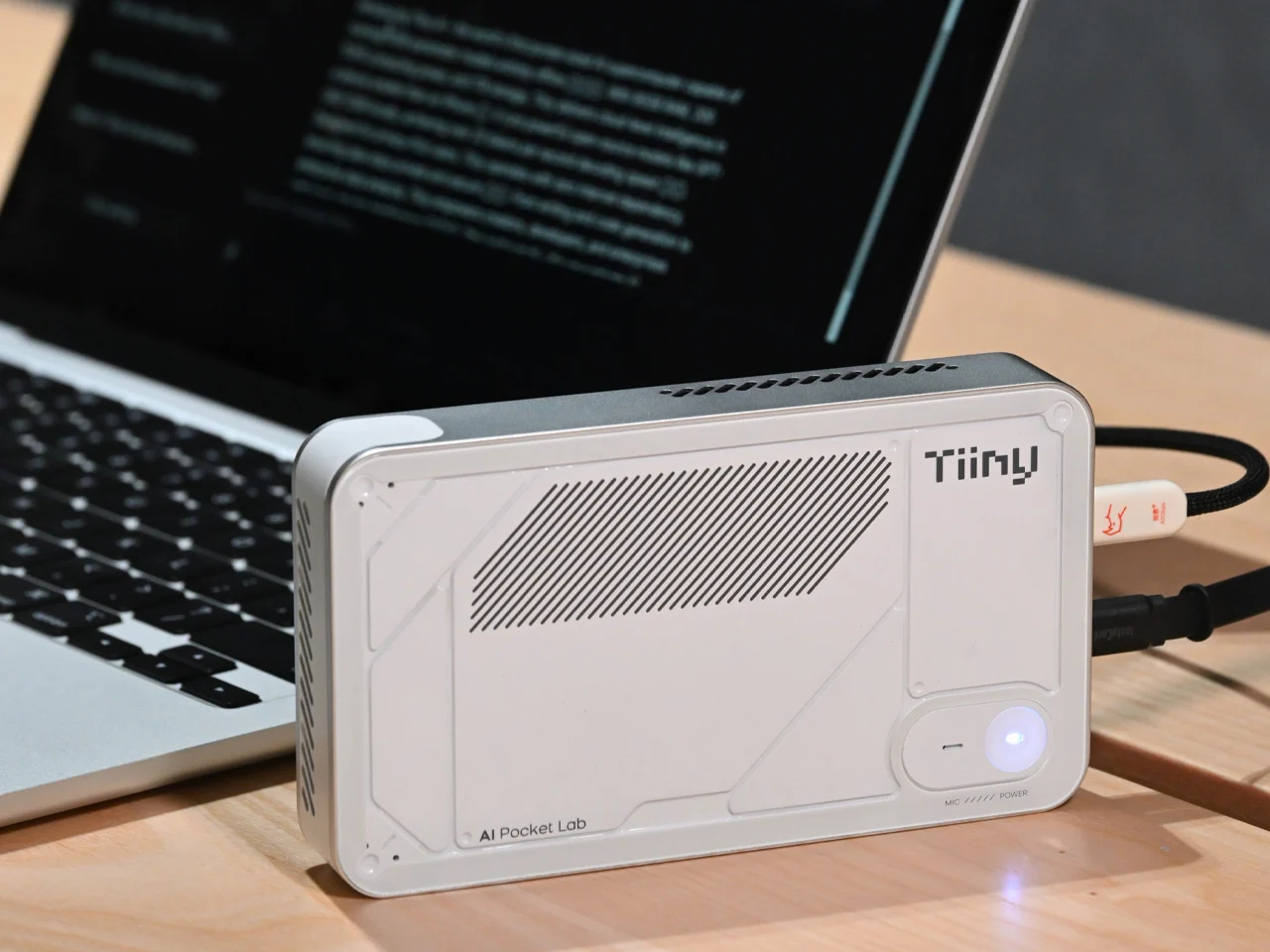
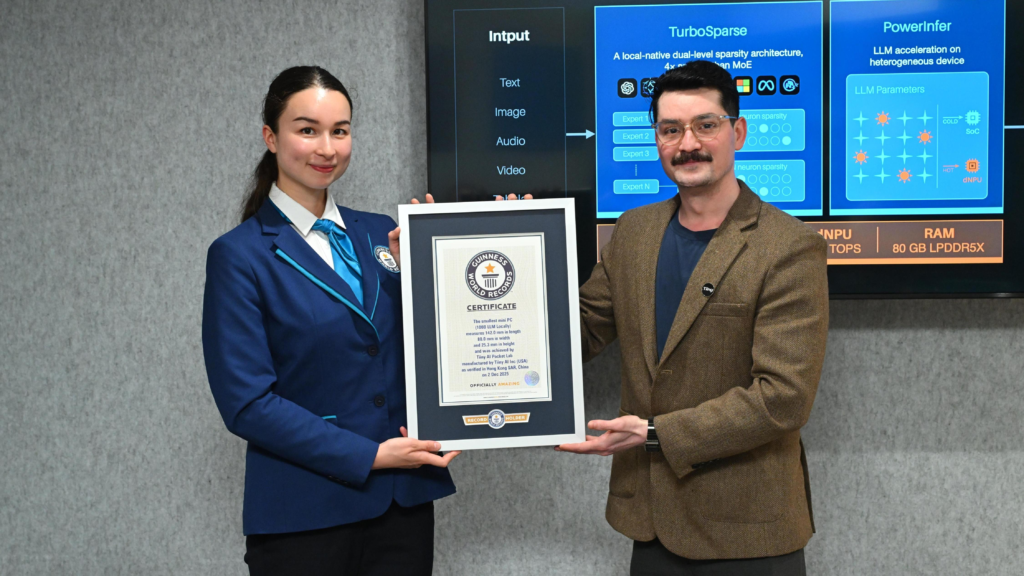
In a groundbreaking announcement on December 10, 2025, US-based deep-tech startup Tiiny AI unveiled the Tiiny AI Pocket Lab, a device officially verified by Guinness World Records as the “Smallest MiniPC (100B LLM Locally).” This pocket-sized marvel represents a paradigm shift in artificial intelligence, bringing server-grade capabilities to a handheld form factor without relying on cloud servers, internet connectivity, or expensive GPUs.
At a time when AI is increasingly dominated by massive data centers consuming enormous energy, the Pocket Lab challenges the status quo by enabling fully private, offline, and energy-efficient AI supercomputing for individuals. Let’s dive deep into what makes this device a potential game-changer.
A Record-Breaking Feat of Miniaturization
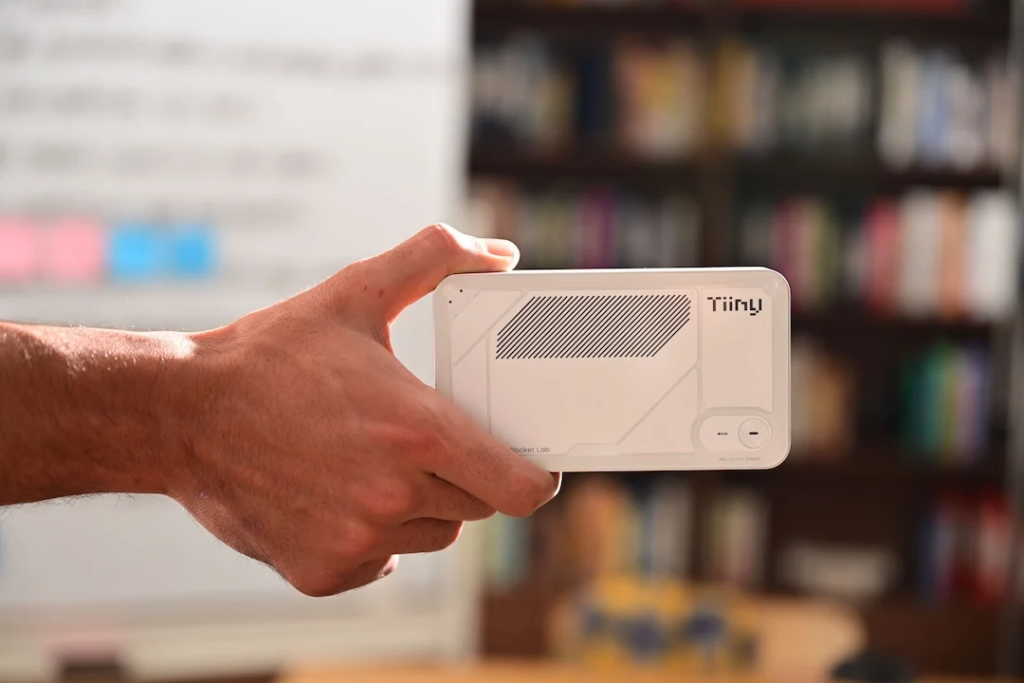
The Tiiny AI Pocket Lab measures just 14.2 × 8 × 2.53 cm—roughly the size of a large power bank—and weighs a mere 300 grams. Despite its diminutive size, it can run large language models (LLMs) with up to 120 billion parameters entirely on-device. This capability, comparable to the intelligence of models like GPT-4o, is achieved through advanced hardware-software co-optimization, making it the first device of its kind to earn Guinness recognition in this highly specific category.
Guinness World Records verified the Pocket Lab as the smallest mini PC capable of locally running a 100-billion-parameter LLM, underscoring Tiiny AI’s engineering prowess.
Hardware Specifications: Power in a Tiny Package
Under the hood, the Pocket Lab is powered by cutting-edge components optimized for AI workloads:
- CPU: 12-core ARM v9.2 processor
- NPU: Discrete neural processing unit delivering approximately 190 TOPS (Tera Operations Per Second) of AI performance
- RAM: 80 GB LPDDR5X for handling massive models with aggressive quantization
- Storage: 1 TB SSD for storing models, data, and applications
- Power Envelope: 30W TDP, with typical operation within a 65W system limit—dramatically more efficient than traditional GPU rigs
This hardware configuration allows the device to operate offline, even powered by a standard power bank, making it truly mobile.
Breakthrough Technologies Enabling the Impossible
Tiiny AI didn’t achieve this through hardware alone. Two key innovations make large-scale local AI feasible:
- TurboSparse: A neuron-level sparse activation technique that accelerates inference speed while preserving model accuracy and intelligence.
- PowerInfer: An open-source heterogeneous inference engine (with over 8,000 GitHub stars) that intelligently distributes workloads between the CPU and NPU, delivering server-like performance at low power consumption.
These optimizations target the “golden zone” of 10B–100B parameter models, which Tiiny AI claims cover over 80% of real-world AI needs, while pushing boundaries to support up to 120B parameters.
The device supports one-click deployment of popular open-source models and tools, including:
- LLMs: Llama, Qwen, DeepSeek, Mistral, Phi, and OpenAI’s GPT-OSS
- Agents/Frameworks: ComfyUI, Flowise, SillyTavern, OpenManus, Presenton, Libra, and Bella
Users also benefit from over-the-air (OTA) updates for continuous improvements.
Why Local AI Matters: Privacy, Sustainability, and Independence
As cloud-based AI services like ChatGPT dominate, they introduce vulnerabilities: data privacy risks, service outages, high latency for long-context tasks, and massive energy consumption contributing to environmental concerns.
Tiiny AI positions the Pocket Lab as a direct alternative:
- Full Privacy: All processing happens on-device with bank-level encryption. User data, preferences, and sensitive information never leave the device.
- Offline Capability: No internet required for advanced reasoning, content generation, or agent workflows.
- Sustainability: Far lower carbon footprint compared to cloud data centers.
- Personal Memory: Long-term storage of personal context for persistent, customized AI experiences.
Samar Bhoj, Tiiny AI’s GTM Director, stated: “Cloud AI has brought remarkable progress, but it also created dependency, vulnerability, and sustainability challenges. Intelligence shouldn’t belong to data centers, but to people.”
This vision targets developers, researchers, creators, professionals, and students who need PhD-level reasoning, multi-step analysis, or secure handling of confidential data.
The Team Behind the Innovation
Founded in 2024, Tiiny AI boasts a stellar team of engineers from MIT, Stanford, HKUST, SJTU, Intel, and Meta. Their expertise in systems engineering, AI optimization, and hardware-software co-design has produced research published in top conferences like SOSP, OSDI, ASPLOS, and EuroSys. In 2025, the company secured a multi-million-dollar seed round from leading global investors.
Comparison to Competitors and Market Context
Existing compact AI devices, such as NVIDIA’s Project Digits (~$3,000) or DGX Spark (~$4,000), are powerful but expensive and less portable. The Pocket Lab aims for broader accessibility, potentially at a lower price point (though exact pricing remains undisclosed).
The global LLM market, valued at $7.4 billion in 2025, is projected to reach $35.4 billion by 2030, fueled by demand for private and edge AI solutions.
Looking Ahead: CES 2026 and Beyond
Tiiny AI plans to showcase the Pocket Lab at CES 2026, where hands-on demos will likely reveal real-world performance. Release date and pricing details are yet to be announced, but the device promises to democratize advanced AI.
The Tiiny AI Pocket Lab isn’t just a gadget—it’s a bold statement about the future of AI: personal, private, portable, and powerful. As we move toward an era of ubiquitous intelligence, devices like this could redefine how we interact with AI, putting supercomputing literally in our pockets.