
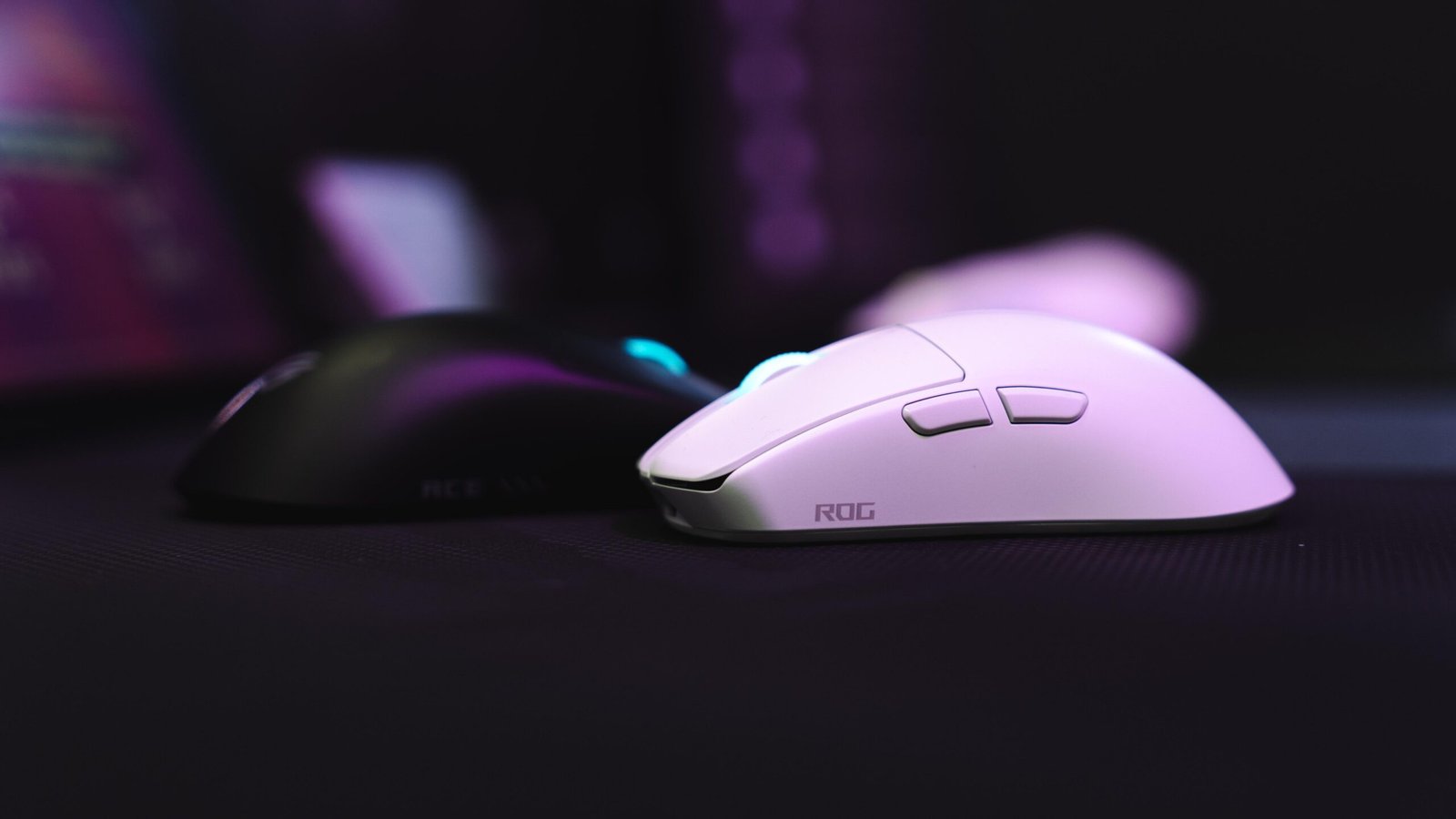
When ASUS launched the original ROG Harpe Ace in 2023, it was an ambitious “almost-there” debut: great shape, solid sensor, but held back by 4K polling, Armoury Crate bloat, and a slightly hollow feel. Two years later, the Harpe II Ace arrives not with fanfare, but with surgical precision — co-developed with 2023 VALORANT Champions winner Max “Demon1” Mazanov — and quietly stakes its claim as one of the best symmetrical wireless mice money can buy in 2025.
First Impressions: 48 Grams of Intentional Design
Unboxing the Harpe II Ace feels like opening a prototype rather than a retail product. At 48 g (yes, really), it undercuts the Razer Viper V3 Pro by 6 g and the Logitech GPX 2 by 12 g without resorting to drilled-out shells or carbon fiber. The weight drop comes from a new bio-based nylon (castor-oil derived, 70 % lower CO₂ footprint) that’s both lighter and tougher than the petroleum plastic of its predecessor.
The shape is the real story. ASUS kept the low-profile, tapered side walls that made the original a claw-grip darling, but filled out the rear hump and smoothed the side grooves. The result is a medium-large symmetrical shell (≈120 × 66 × 39 mm) that feels noticeably more confident in hand than the original, especially for 18–21 cm hands. Coating is matte and velvety — eco-friendly, but undeniably a fingerprint magnet. ASUS includes two sets of grip tape for sweaty palms or humid LAN environments.
Under the Hood: Pro-Grade Everything
- Sensor: ROG AimPoint Pro optical – 42 000 DPI, 750 IPS, 50 g, track-on-glass
- Switches: ROG Optical Micro Switches (100-million-click rating, crisp medium travel)
- Wireless: ROG SpeedNova tri-mode – true 8 000 Hz polling without a booster dongle
- Battery: Up to 101 hours at 1K Hz; ~10–12 hours at full 8K (15-minute charge = 12 hours)
- Feet: 100 % PTFE, rounded edges, superb glide out of the box
The 8K wireless implementation is the headline. Unlike most competitors that require a wired dongle or proximity booster, the Harpe II Ace hits 8 000 Hz natively over 2.4 GHz across a normal desk-sized area. Latency tests (NVIDIA Reflex Analyzer, Raw Input Buffer) put it within 0.1–0.2 ms of the Viper V3 Pro and ahead of the GPX 2’s 4K ceiling.
New Tricks: Zone Mode and Browser-Based Config
ASUS finally ditched Armoury Crate. Configuration now happens entirely through gearlink.asus.com — open a browser, plug in the mouse, done. No background services, no 300 MB installers, perfect for tournament PCs.
The standout feature is “Zone Mode” — a single physical button on the bottom that instantly switches to a pre-configured “tournament profile”: max polling, sensor motion sync on, RGB off, lift-off distance 1 mm. Pros at VCT events have been spotted flipping it mid-match.
Side-by-Side: How It Stacks Up in Late 2025
| Mouse | Weight | Max Wireless Polling | Sensor Max DPI | Battery (1K Hz) | Price (Street) | Shape Notes |
|---|---|---|---|---|---|---|
| ROG Harpe II Ace | 48 g | 8K Hz (native) | 42K | 101 hrs | ~$169 | Fuller rear, low profile |
| Razer Viper V3 Pro | 54 g | 8K Hz | 35K | 95 hrs | ~$159 | Slightly wider, flatter |
| Logitech GPX 2 DEX | 60 g | 8K Hz (2025 refresh) | 44K | 95 hrs | ~$159 | More relaxed claw/palm |
| Finalmouse ULX (Large) | 31–47 g | 8K Hz | 32K | ~70 hrs | $189+ | Polarizing shapes, QC risk |
| Lamzu Thorn | 52 g | 8K Hz | 32K | 90 hrs | ~$99 | Budget king, softer clicks |
Against the Viper V3 Pro, the Harpe feels snappier in flicks because of the lower front height and 6 g advantage. Against the GPX 2, it’s simply faster and more agile. Only hyper-light Finalmouse options beat it on raw weight, but at the cost of reliability and battery life.
Real-World Feel
After 200+ hours across VALORANT, CS2, Apex, and productivity:
Clicks: Light, defined, zero side play. Some users find them “too soft” compared to heavier mechanical switches, but for pure speed they’re perfect.
Scroll wheel: Tight notches, quiet, but a few units exhibit faint reverse-direction rattle (non-issue in-game).
Side buttons: Short travel, spammable — among the best in class.
Coating: Slippery when dry, excellent with grip tape or slight palm sweat.
Tracking: Flawless, even on glass desks or cloth pads at 8K.
Minor Nitpicks (Because Nothing Is Perfect)
- No onboard memory for multiple deep profiles
- DPI switch still on the bottom (no side-button option by default)
- White version shows dirt faster than expected
- Occasional reports of faint main-button creak when lifting (QC lottery, ~5–10 % of units)
Verdict: 9.2 / 10 – The New Benchmark for Symmetrical Ultralights
The ROG Harpe II Ace doesn’t scream for attention with RGB or wild marketing. It just works — and works exceptionally well. For competitive FPS players who claw or fingertip grip and want the absolute cutting edge of wireless performance without jumping through hoops, it is currently the most complete package you can buy.
If you loved the original Harpe Ace but wished it were lighter, faster, and free of Armoury Crate, ASUS just granted your wish — and then some.
Buy it if:
→ You main VALORANT/CS2/Apex with claw or fingertip grip
→ You value native 8K + top-tier battery + pro-tuned shape
→ You hate bloated software
Look elsewhere if:
→ You’re a dedicated palm-gripper (try GPX 2 DEX or Dav3)
→ You’re left-handed (still no love, sorry)
→ You want to spend under $120 (grab the original Harpe Ace on sale)
In a market flooded with clones and compromises, the Harpe II Ace is the rare 2025 release that actually moves the needle. ASUS didn’t just catch up — for once, they leapt ahead.