
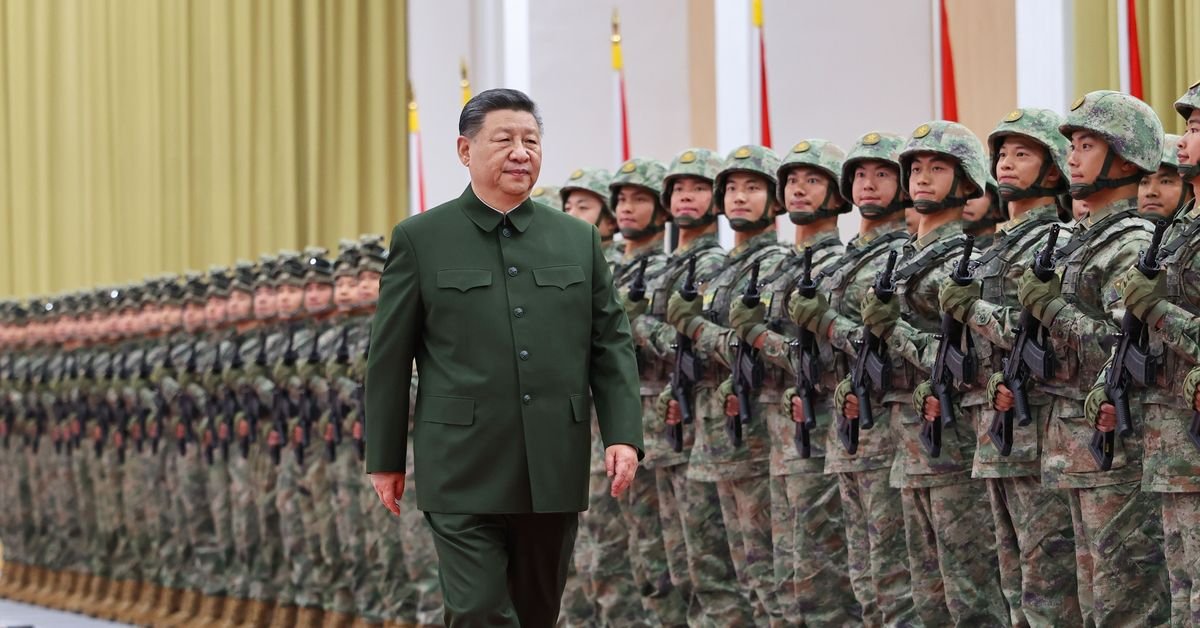
In a bold display of military might, China’s People’s Liberation Army (PLA) has launched extensive war games around Taiwan, dubbed “Justice Mission 2025,” involving live-fire exercises and simulated blockades. The drills, which began on Monday and continued with major activities on Tuesday, are intended as a stark warning to “Taiwan independence” separatist forces and external interference, particularly from the United States and Japan. This escalation comes on the heels of a massive U.S. arms sale to Taiwan and provocative statements from Japan’s prime minister, heightening already fraught tensions in the Indo-Pacific region.
The exercises encompass a wide array of forces, including the army, navy, air force, and rocket force. They feature sea-air combat readiness patrols, joint operations to seize control of key areas, blockades of Taiwan’s major ports like Keelung and Kaohsiung, and live-firing against sea and land targets. China’s Eastern Theater Command deployed destroyers, frigates, fighters, bombers, unmanned aerial vehicles, and long-range rockets across multiple zones in the Taiwan Strait and surrounding areas. Notably, the drills expanded to a record seven zones, some closer to Taiwan than in previous iterations, and included innovative elements like automated humanoid robots, microdrones, and weaponized robotic dogs in propaganda videos released by the PLA.
Beijing’s official narrative frames these maneuvers as a “stern warning” and a “shield of justice” against separatist activities and foreign meddling. A spokesperson for the Eastern Theater Command emphasized that the operations are “legitimate and necessary” to safeguard China’s sovereignty and national unity. Posters released alongside the drills bore slogans like “Shield of Justice, Smashing Illusion,” while a Weibo post declared, “All those plotting independence will be annihilated upon encountering the shield!” Chinese Foreign Ministry spokesman Lin Jian further accused external forces of “using Taiwan to contain China,” warning that any schemes to obstruct reunification are “doomed to fail.”
The immediate triggers for these drills appear rooted in recent actions by the U.S. and Japan. Just 11 days prior, the United States announced an unprecedented $11.1 billion arms package to Taiwan—the largest ever—if approved by Congress. This includes advanced weaponry that could enhance Taiwan’s defenses, such as U.S.-made HIMARS rocket systems capable of reaching mainland China. Beijing responded with protests, sanctions on 20 U.S. defense companies and 10 executives, and vows of “forceful measures.” Additionally, Japan’s Prime Minister Sanae Takaichi recently suggested that a Chinese attack on Taiwan could prompt military involvement from Tokyo, a statement that drew sharp rebukes from China and led to protests over incidents like Chinese jets locking radar on Japanese aircraft. These developments have amplified Beijing’s concerns over increasing interoperability between Taiwanese and U.S. systems, potentially risking direct superpower confrontation.
Taiwan, which rejects China’s sovereignty claims and asserts that only its people can determine the island’s future, has responded with defiance and preparedness. The Taiwanese Defense Ministry placed its forces on high alert, conducting rapid response exercises and deploying troops, coast guard ships, and missile systems to monitor and counter the Chinese activities. On Monday, it detected 89 Chinese military aircraft, 14 vessels, and 14 coast guard boats operating around the island. Spokesperson Karen Kuo from the president’s office condemned the drills as undermining stability in the Taiwan Strait and the broader Indo-Pacific, labeling the Chinese Communist Party as the “biggest destroyer of peace.” President Lai Ching-te, in a recent interview, vowed to boost defense spending and raise the bar for any potential invasion, emphasizing that peace requires “real strength” while committing to maintain the status quo without provocation. Taiwan also released videos showcasing its own capabilities, including French Mirage-2000 jets and HIMARS systems, to demonstrate resilience.
From Washington’s perspective, the U.S. is legally obligated under federal law to assist Taiwan’s defense, viewing the island as a critical bulwark against Chinese expansionism. The arms sale underscores this commitment, though it has drawn Beijing’s ire. Analysts note that China’s exercises are blurring the lines between routine training and attack preparations, potentially reducing warning times for U.S. and allied interventions. Japan, meanwhile, has ramped up its own defenses, approving a record budget to deter China, amid ongoing disputes over territorial claims and military incursions.
This marks the sixth major round of Chinese war games around Taiwan since 2022, initiated after events like then-U.S. House Speaker Nancy Pelosi’s visit and President Lai’s inauguration. Unlike previous drills, these explicitly emphasize “all-dimensional deterrence outside the island chain,” signaling Beijing’s intent to isolate Taiwan from external support. Experts, such as Fu Zhengyuan from China’s Academy of Military Science and Chieh Chung from Taiwan’s Institute for National Defence and Security Research, interpret the maneuvers as a direct response to perceived provocations, testing both Taiwan’s resolve and the effectiveness of U.S.-supplied weapons.
As the drills unfold, they pose complex challenges for international maritime routes, fishing grounds, and airspace, with Taiwan’s aviation authority rerouting flights to mitigate disruptions. The broader implications ripple through regional security, challenging international norms and heightening the risk of miscalculation in one of the world’s most volatile flashpoints. While China insists on its right to “non-peaceful means” to prevent secession, Taiwan and its allies remain vigilant, underscoring the fragile balance of power in the Taiwan Strait.