
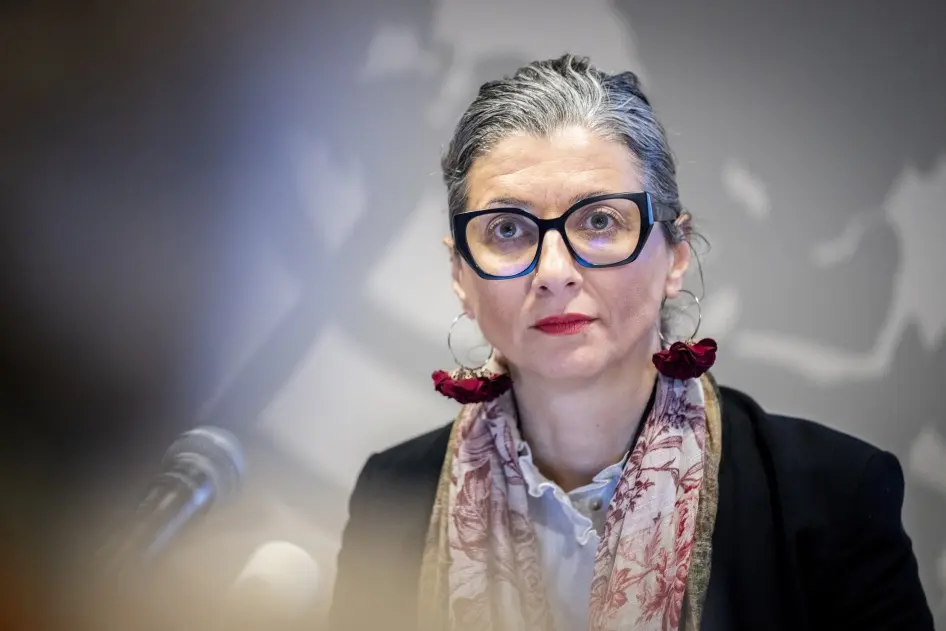
In a quiet but significant move, Georgetown University has removed Francesca Albanese, the United Nations Special Rapporteur on the situation of human rights in the Palestinian territories occupied since 1967, from its list of affiliated scholars. Her profile, previously prominent on the website of the university’s Institute for the Study of International Migration (ISIM), has been deleted, ending an academic affiliation that had drawn increasing scrutiny.
The decision, first highlighted by the Geneva-based NGO UN Watch on December 21, 2025, comes amid a sustained campaign criticizing Albanese for alleged antisemitism and support for terrorism. UN Watch Executive Director Hillel Neuer praised the removal, stating it upholds academic integrity and calling on the UN to follow suit.
Georgetown University, a prestigious Jesuit institution in Washington, D.C., known for its historic campus and focus on international affairs, has not issued an official statement on the matter.
Albanese, in a recent interview, attributed the loss of her U.S. university affiliation to sanctions imposed by the United States in July 2025, describing it as a “betrayal” with profound personal impacts.
Historical Background: The UN Mandate on Palestinian Territories
The position held by Albanese traces its roots to 1993, when the UN Commission on Human Rights (predecessor to the Human Rights Council) established the “Special Rapporteur on the situation of human rights in the Palestinian territories occupied since 1967.” The mandate focuses exclusively on investigating alleged Israeli violations of international law in the West Bank, East Jerusalem, and Gaza, without a symmetric examination of actions by Palestinian authorities or groups.
Critics, including Israel and the United States, have long viewed the mandate as inherently biased, as it predetermines Israel as the sole violator and does not require cooperation from Palestinian entities. Previous rapporteurs, such as Richard Falk and Michael Lynk, faced similar accusations of anti-Israel bias. Israel has consistently denied access to the occupied territories for these experts, forcing reliance on secondary sources.
Francesca Albanese, an Italian international lawyer born in 1977, became the first woman in the role when appointed in May 2022. With degrees from the University of Pisa and SOAS University of London, she previously worked with UN agencies like UNRWA and OHCHR on refugee and human rights issues. Her reports have accused Israel of apartheid, settler-colonialism, and, in 2024-2025, genocide in Gaza—claims strongly rejected by Israel and its allies.
Escalating Controversies and International Backlash
Albanese’s tenure has been marked by intense debate. Supporters praise her for highlighting Palestinian suffering and structural injustices under occupation. Detractors, including governments and NGOs, accuse her of antisemitic rhetoric, Holocaust inversion, and justifying violence.
A key flashpoint came in February 2024, when Albanese responded to French President Emmanuel Macron’s description of the October 7, 2023, Hamas attacks—which killed over 1,200 Israelis and took hundreds hostage—as the “largest antisemitic massacre of our century.” Albanese countered that the victims were killed “in response to Israeli oppression,” not because of their Judaism. This drew unprecedented condemnations from France, Germany, and Canada for antisemitism—the first time multiple Western governments jointly rebuked a UN rapporteur on such grounds.
UN Watch’s 60-page dossier documented additional statements, including comparisons of Israeli policies to Nazi practices and allegations of undue “Jewish lobby” influence in the U.S. Albanese has denied antisemitism, framing criticisms as attempts to silence advocacy for Palestinian rights.
In July 2025, the U.S. administration sanctioned Albanese under an executive order targeting perceived “lawfare” against American and Israeli nationals, citing her engagement with the International Criminal Court. The sanctions froze assets and restricted financial activities, prompting UN experts to defend her immunity and condemn the move as an attack on independent human rights monitoring.
The Georgetown Affiliation and Its End
Albanese had been listed as an “Other Affiliated Scholar” at Georgetown’s ISIM, a non-resident role that lent academic credibility and facilitated lectures. UN Watch campaigned for over six months for her removal, arguing universities should not platform individuals accused of promoting hatred.
The quiet delisting in late December 2025 aligns with broader pressures on U.S. academic institutions amid debates over foreign funding, free speech, and antisemitism following the October 7 attacks and subsequent Gaza war.
While Georgetown remains silent, the development underscores tensions between academic freedom, institutional accountability, and geopolitical controversies. For Albanese, it adds to professional isolation amid her ongoing UN mandate, renewed until 2028. The episode reflects deeper divisions over the Israeli-Palestinian conflict, where human rights reporting often becomes a battleground for competing narratives.