
In the hyper-polarized landscape of 2025 American politics, few figures have crossed ideological lines as dramatically as Nicki Minaj. The Trinidad-born rap icon, once celebrated for empowering anthems and subtle nods to progressive causes, has emerged as an unlikely champion for conservative priorities. Her journey from criticizing Donald Trump’s immigration policies to praising him as a “role model” for young men and addressing the United Nations on religious freedom has captivated—and divided—observers across the political spectrum.
Minaj’s political prominence isn’t rooted in holding office or drafting legislation. Instead, it stems from her massive platform: over 20 million followers on X (formerly Twitter), a devoted fanbase known as the “Barbz,” and an unfiltered voice that commands global attention. In an era where celebrity tweets can eclipse policy announcements, Minaj has demonstrated how entertainment and politics increasingly intersect.
The 2021 Vaccine Controversy: Minaj’s First Major Political Splash
Minaj’s entry into the political spotlight came abruptly in September 2021, amid the COVID-19 vaccine rollout. Skipping the Met Gala due to its vaccination requirement, she tweeted a personal anecdote: her cousin in Trinidad refused the vaccine after a friend allegedly suffered swollen testicles and impotence post-jab. The claim, quickly debunked by health officials—including Trinidad’s health minister and Dr. Anthony Fauci—went viral, sparking international headlines.
The White House offered Minaj a call with doctors to address her concerns, while figures like Tucker Carlson praised her for questioning mandates. UK and Trinidadian officials publicly refuted her story, and it fueled vaccine hesitancy debates. Though Minaj later encouraged research and vaccination, the episode highlighted her ability to dominate discourse. Conservative media embraced her skepticism, planting seeds for future alignment.
A Gradual Shift: From Critic to Supporter
For years, Minaj’s politics appeared left-leaning or apolitical. She criticized Trump’s family-separation policies at the border, celebrated LGBTQ+ fans in her music, and distanced herself from partisan endorsements. Yet by 2025, subtle changes emerged: reposting Trump-friendly content, sharing fan edits of the president dancing to her songs, and engaging with conservative narratives.
The turning point came in late 2025 over religious persecution in Nigeria. Trump posted on Truth Social about “Christianity facing an existential threat” there, threatening action against the government. Minaj, drawing on her Christian faith and Trinidadian roots, amplified it: “Reading this made me feel a deep sense of gratitude… Thank you to the president & his team for taking this seriously. God bless every persecuted Christian.”
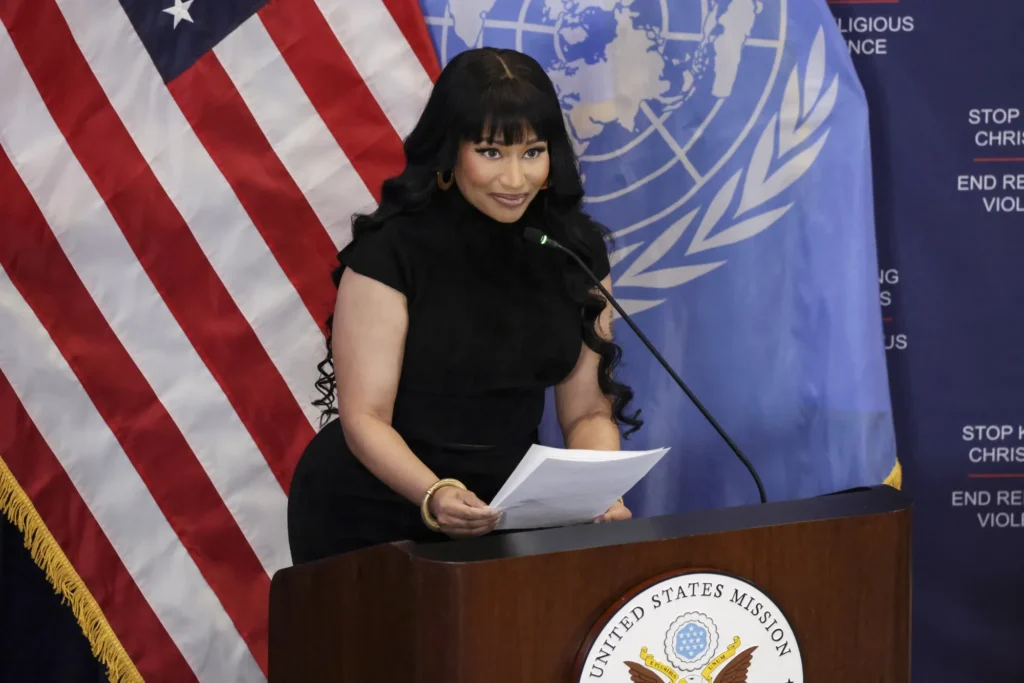
This resonated deeply. U.S. Ambassador to the UN Mike Waltz invited her to a November 2025 panel at the U.S. Mission to the United Nations titled “Combatting Religious Violence and the Killing of Christians in Nigeria.” Minaj spoke passionately: “Faith is under attack… Protecting Christians in Nigeria is not about taking sides… It is about uniting humanity.” She thanked Trump for his leadership, earning praise from the administration while drawing criticism for oversimplifying complex violence often tied to resources and ethnicity rather than solely religion.
AmericaFest 2025: Minaj Goes Full MAGA
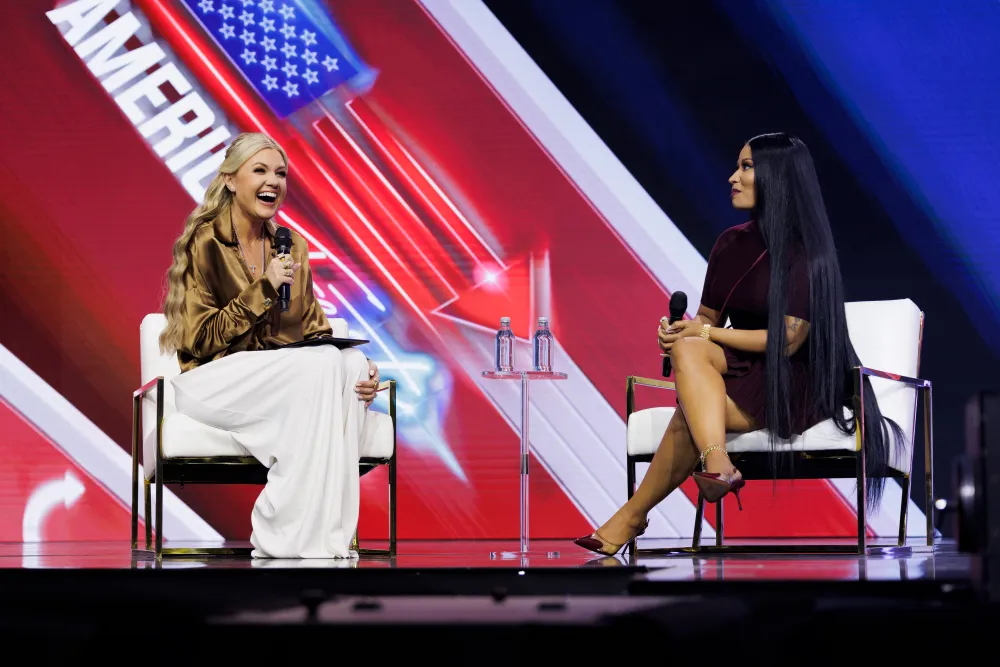
The culmination came on December 21, 2025, at Turning Point USA’s AmericaFest in Phoenix—a major conservative conference honoring the late founder Charlie Kirk (assassinated earlier that year). Minaj appeared as a surprise guest, interviewed by new CEO Erika Kirk (Charlie’s widow).
Hand-in-hand with Kirk amid fireworks and cheers, Minaj was effusive: “I have the utmost respect and admiration for our president… He’s given so many people hope.” She called Trump and Vice President JD Vance “role models” for young men, praising their relatability and “heart and soul.” Minaj mocked California Gov. Gavin Newsom as “Newscum,” criticized trans youth policies, and rejected “zero-sum” identity politics: “Just because I want little Black girls to think they’re beautiful doesn’t mean I need to put down little girls with blonde hair and blue eyes.”
She explained her shift: “I just got tired of being pushed around… We’re not allowed to have a different opinion anymore.” Despite industry backlash, Minaj declared conservatives “the cool kids” and vowed to speak out.
An awkward moment arose when Minaj called Vance an “assassin” (meaning sharp debater), quickly correcting herself amid the sensitive context of Kirk’s loss. Vance later praised her on X for rejecting division.
Why Minaj’s Influence Feels “More Important” Than Politicians’
Minaj doesn’t wield institutional power, but her cultural reach amplifies issues instantaneously. Her Nigeria advocacy drew responses from world leaders; her AmericaFest appearance generated more buzz than many congressional speeches. In a fragmented media environment, celebrities like Minaj shape narratives, mobilize fans, and force reactions from elites.
This mirrors broader trends: Trump’s own rise via reality TV, or Elon Musk’s platform power. Minaj’s evolution—fueled by faith, frustration with “bullying,” and alignment on culture-war issues—makes her a crossover star in MAGA circles, rare for hip-hop artists whose peers lean Democratic.
Critics argue her claims (e.g., on Nigeria) simplify nuanced conflicts, and her past progressive stances make the shift jarring. Supporters hail her courage in defying industry norms.
The Bigger Picture: Celebrity in the Culture Wars
Minaj’s story underscores how politics now thrives on symbolism and virality. She’s not “more important” than politicians in governing, but in capturing attention and shifting conversations? In 2025, absolutely. As she puts it: “It’s OK to change your mind.”
Whether this endures or evolves, Nicki Minaj has proven that in today’s America, a rap queen’s voice can echo louder than many in Washington.