
In a significant boost to economic relations, India and New Zealand have successfully concluded negotiations for a comprehensive Free Trade Agreement (FTA). Announced jointly by Prime Minister Narendra Modi and New Zealand Prime Minister Christopher Luxon following a telephone conversation, the pact is described as “historic, ambitious, and mutually beneficial.” Concluded in a record nine months since formal launch in March 2025, this agreement marks India’s third FTA in 2025, following deals with the United Kingdom and Oman.
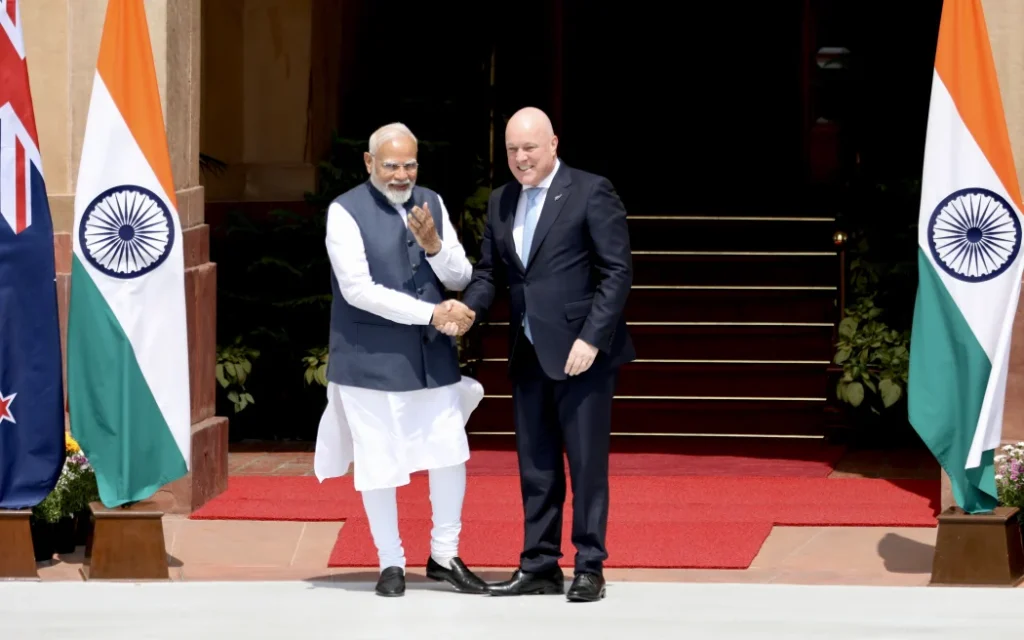
The leaders pose for photographs during earlier meetings, symbolizing the strengthening partnership between the two nations.
Background and Timeline
Negotiations for the India-New Zealand FTA were formally launched on March 16, 2025, during Prime Minister Luxon’s visit to India, where he met PM Modi in New Delhi. The rapid conclusion—after five formal rounds and multiple inter-sessional discussions—reflects strong political will and shared ambition to deepen ties. This aligns with India’s vision of Viksit Bharat 2047 (Developed India by 2047) and New Zealand’s goal to expand export markets amid global uncertainties.
Current bilateral trade in goods and services stands at approximately $2.4 billion (as of 2024), with merchandise trade at $1.3 billion. India enjoys a trade surplus, driven by pharmaceuticals, textiles, and services like IT. New Zealand’s exports include agricultural products such as kiwifruit, apples, logs, and wool.
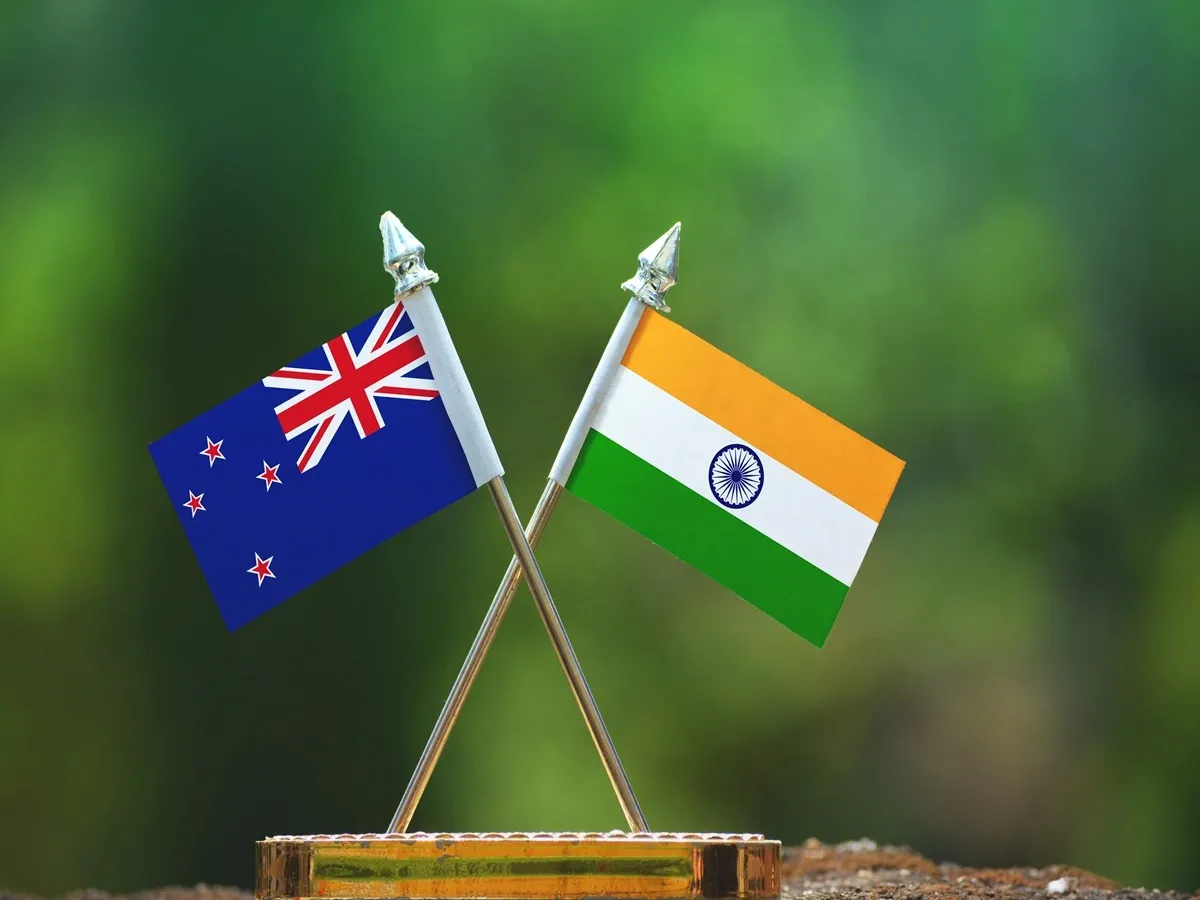
The flags of India and New Zealand symbolize the new era of cooperation under the FTA.
Key Provisions of the Agreement
The FTA is comprehensive, covering goods, services, investment, mobility, and trade facilitation. Highlights include:
- Tariff Reductions:
- New Zealand eliminates tariffs on 100% of its tariff lines, granting zero-duty access to all Indian exports.
- India liberalizes tariffs on 70% of tariff lines, covering 95% of New Zealand’s current exports to India. Over half of these will become duty-free immediately upon entry into force.
- Protected Sectors:
- India has excluded sensitive areas like dairy (milk, cheese, yoghurt), onions, sugar, edible oils, and certain animal/vegetable products to safeguard domestic farmers and industries. Dairy remains a red line for India.
- Expected Trade Impact:
- Bilateral trade is projected to double within five years.
- New Zealand’s exports to India could increase by $1.1–1.3 billion annually over the next two decades.
- Overall boost aligns with hundreds of millions (potentially billions) in additional trade value.
- Investment Commitment:
- New Zealand pledges to facilitate $20 billion in investments into India over 15 years, supporting sectors like manufacturing, infrastructure, and innovation under India’s Make in India initiative.
- Services and Mobility:
- Ambitious commitments in services, including IT, professional services, education, tourism, and financial services.
- Enhanced mobility: Up to 5,000 temporary employment visas for Indian professionals (up to three years) and 1,000 working holiday visas annually.
- Opportunities in sectors like yoga, culinary arts, music, engineering, and healthcare.
- Agriculture Cooperation:
- Dedicated action plans for kiwifruit, apples, and honey focusing on productivity, research, and value chains—benefiting Indian farmers without opening sensitive markets.
Iconic exports: New Zealand kiwifruit and timber alongside Indian textiles and pharmaceuticals stand to gain from reduced barriers.
Benefits for India
- Export Boost: Duty-free access for labour-intensive sectors like textiles, apparel, leather, footwear, marine products, gems & jewellery, handicrafts, engineering goods, automobiles, pharmaceuticals, and chemicals.
- Support for MSMEs and Youth: Deeper global value chain integration for artisans, women, youth, and small businesses.
- Services Edge: India’s IT and professional services gain predictable access to New Zealand’s market.
- Strategic Gains: Diversifies export markets amid global trade uncertainties, including high US tariffs on Indian goods.
Benefits for New Zealand
- Market Access: Predictable entry to India’s fast-growing economy (projected to reach $7 trillion by 2030) for agricultural and forestry products.
- Job Creation: Higher exports mean more jobs, wages, and opportunities for Kiwis.
- Fulfills Promise: Delivers on the National Party’s 2022 election commitment to finalize an India FTA.
Next Steps and Broader Implications
The agreement is expected to be formally signed in the first half of 2026, followed by legal review and ratification, with entry into force shortly thereafter.
This FTA strengthens Indo-Pacific cooperation, enhances people-to-people ties (including education and sports), and positions both nations for resilient growth. As PM Modi stated, “The India-NZ partnership is going to scale newer heights.” For New Zealand, it opens doors to 1.4 billion consumers in one of the world’s fastest-growing economies.
While some criticism emerged in New Zealand regarding immigration provisions, the deal is widely seen as balanced and forward-looking.
This landmark agreement not only promises economic gains but also reinforces the strong friendship between India and New Zealand, paving the way for a prosperous shared future.