
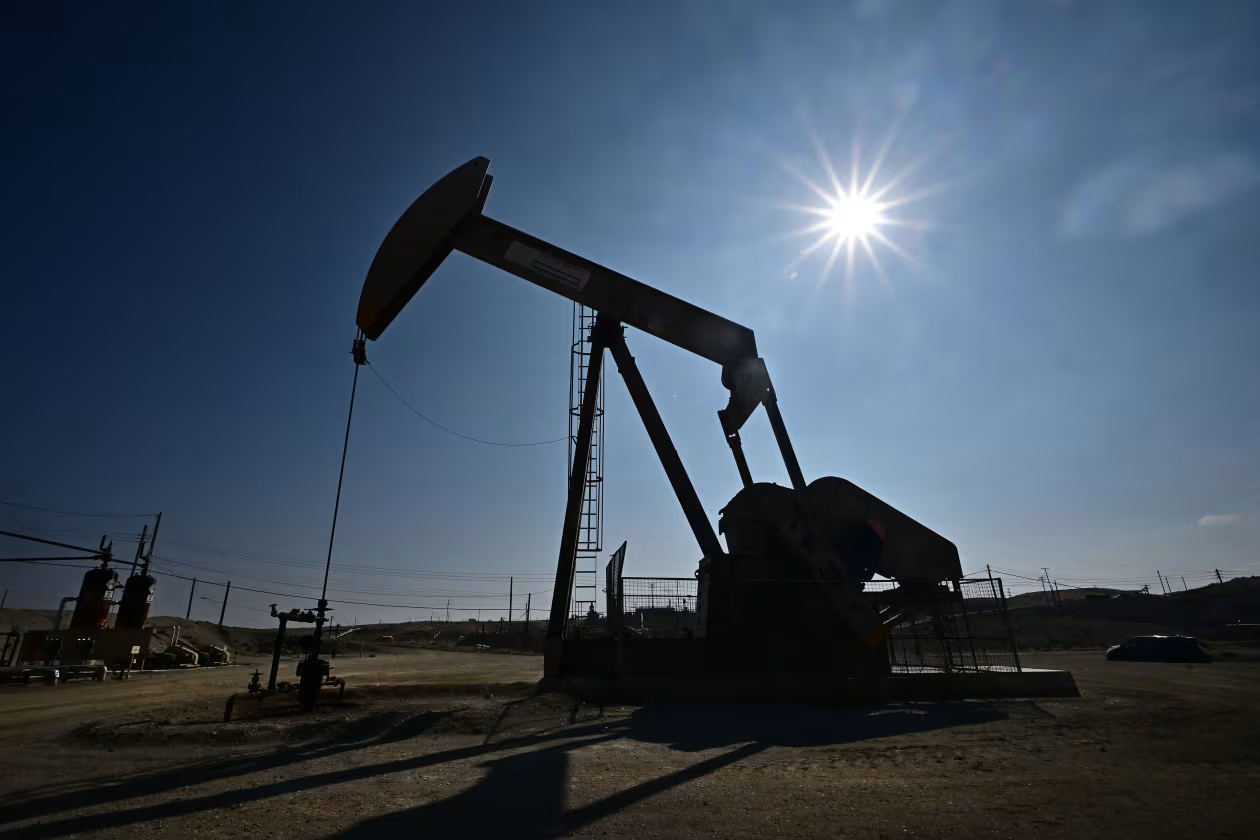
In a dramatic turn of events that underscores the fragility of global commodity markets, crude oil prices have settled at their lowest levels since early 2021, driven largely by mounting optimism surrounding a potential ceasefire in the Russia-Ukraine conflict. As of December 15, 2025, West Texas Intermediate (WTI) crude futures closed at $56.82 per barrel, marking a decline of 62 cents or 1.08% from the previous session, while Brent crude settled at $60.56 per barrel, down 56 cents or 0.92%. This downturn represents a weekly loss of approximately 4%, highlighting how geopolitical de-escalation can swiftly erode the risk premiums baked into oil valuations. But what does this mean for the broader energy landscape? This article delves deep into the statistics, underlying factors, economic ramifications, and future projections, drawing on recent market data and expert analyses to provide a comprehensive overview.
Historical Context: From COVID Lows to War-Driven Spikes and Back Again
To fully appreciate the significance of the current price slump, it’s essential to examine oil’s volatile journey over the past few years. In early 2021, as the world grappled with the lingering effects of the COVID-19 pandemic, WTI crude averaged around $57 per barrel for the year, with lows dipping into the mid-$40s during periods of demand uncertainty. Brent crude followed a similar trajectory, averaging about $71 but experiencing troughs below $50. These levels were a far cry from the pre-pandemic norms, where prices often hovered in the $60-$70 range, supported by steady global demand growth of 1-2 million barrels per day (bpd) annually.
The landscape shifted dramatically in February 2022 with Russia’s invasion of Ukraine. Oil prices surged as Western sanctions disrupted Russian exports, which accounted for roughly 11% of global supply at the time (about 10.5 million bpd in production). WTI peaked above $120 per barrel in March 2022, while Brent hit $139—the highest since 2008. According to data from the International Energy Agency (IEA), this geopolitical shock added a risk premium of up to $20-$30 per barrel, pushing global average prices to $100 for WTI and $105 for Brent in 2022. The war also exacerbated supply chain issues, with Russian crude exports dropping by 1.5 million bpd in the initial months due to sanctions and self-imposed restrictions by buyers.
Fast-forward to 2023-2024, and prices moderated amid resilient non-OPEC production. The U.S., for instance, ramped up output to a record 13.3 million bpd in 2024, representing over 13% of global supply. Brazil and Guyana contributed an additional 0.5 million bpd combined through new offshore developments. Meanwhile, global demand growth slowed to 1.2 million bpd in 2024, per OPEC estimates, weighed down by economic headwinds in China, where industrial activity contracted by 0.5% year-over-year in Q3 2024. By mid-2025, prices had stabilized in the $70-$80 range, but the persistent threat of escalation in Ukraine kept a floor under valuations.
Now, in December 2025, the pendulum has swung back. The recent settlements mark a 25% drop from the 2025 year-to-date high of $85 per barrel for WTI in April, underscoring how quickly sentiment can shift. Historical comparisons reveal that current levels are comparable to January 2021’s averages, when global inventories were bloated by 300 million barrels above five-year norms due to pandemic lockdowns. Today’s inventories, however, stand at 4.5 billion barrels globally—still 100 million above pre-war levels—amplifying the bearish outlook.
| Year | WTI Average Price ($/bbl) | Brent Average Price ($/bbl) | Key Event Influencing Prices | Global Demand Growth (million bpd) |
|---|---|---|---|---|
| 2021 | 68.00 | 71.00 | COVID-19 recovery | 5.5 (rebound) |
| 2022 | 95.00 | 100.00 | Russia-Ukraine invasion | 2.5 |
| 2023 | 78.00 | 83.00 | Sanctions and OPEC+ cuts | 2.3 |
| 2024 | 75.00 | 80.00 | Non-OPEC supply surge | 1.2 |
| 2025 (YTD) | 70.00 | 75.00 | Ukraine peace talks | 1.0 (projected) |
Sources: Compiled from IEA, OPEC, and market reports; averages are approximate based on available data.
Current Market Dynamics: A Perfect Storm of Oversupply and De-Escalation
The immediate catalyst for the December 2025 plunge has been the intensifying diplomatic efforts to broker a Ukraine ceasefire under U.S. President Donald Trump’s administration. Reports from Berlin negotiations indicate “significant progress” on security guarantees for Ukraine, with Trump describing talks as “very constructive” and a deal “closer than ever.” Traders are betting that a resolution could lift or ease sanctions on Russian oil, potentially adding 1-2 million bpd back to the market. Russia currently exports about 5 million bpd, but sanctions have rerouted much of this to India and China at discounted rates—up to $20 below global benchmarks.
Compounding this is a backdrop of robust supply. U.S. crude inventories rose by 2.8 million barrels in the week ending December 12, 2025, according to the Energy Information Administration (EIA), pushing stocks to 430 million barrels—5% above the five-year average. Non-OPEC production is projected to grow by 1.8 million bpd in 2026, led by the U.S. (0.9 million bpd increase), Guyana (0.2 million bpd from new fields), and Brazil (0.3 million bpd). On the demand side, China’s oil imports fell 10% year-over-year in November 2025 to 10.5 million bpd, reflecting a GDP growth slowdown to 4.5%—below the government’s 5% target.
Saudi Arabia’s recent moves have further pressured prices. State-owned Aramco slashed its official selling price for Arab Light crude to Asian buyers by $2 per barrel for January 2026 deliveries, marking the lowest level since 2021. This aggressive pricing strategy aims to defend market share amid competition from cheaper Russian barrels, but it signals a bearish outlook from the world’s largest exporter (9.5 million bpd capacity).
Offsetting these downward forces are emerging risks, such as escalating U.S.-Venezuela tensions. The U.S. seizure of a Venezuelan oil tanker in early December disrupted flows, with Venezuela’s production at 0.8 million bpd—down from 2.5 million pre-sanctions in 2018. This led to a slight rebound in prices on December 15, as markets weighed potential supply losses of 0.5 million bpd if sanctions tighten further. However, these concerns have not been sufficient to counter the broader oversupply narrative.
Statistical Breakdown: Supply, Demand, and Inventory Trends
Diving deeper into the numbers, global oil supply stood at 103 million bpd in November 2025, per IEA data, outpacing demand by 1.2 million bpd and leading to inventory builds. OPEC+ compliance with production cuts remains spotty; the group, which controls 48% of global output, agreed to withhold 5.8 million bpd in 2025 but has overproduced by 0.5 million bpd on average due to members like Iraq and Kazakhstan exceeding quotas.
Demand-side statistics paint a mixed picture. Global consumption is forecast at 103.5 million bpd for 2025, up just 0.9% from 2024—the slowest growth since 2020. China, the world’s top importer at 11.5 million bpd annually, saw refinery throughput drop 3% in Q4 2025 amid weak manufacturing PMI readings of 49.5 (below 50 indicates contraction). In contrast, India—now Russia’s top buyer—imported 1.8 million bpd from Russia in 2025, representing 40% of its total oil needs and helping stabilize its import bill at $150 billion annually.
Inventory levels provide another key metric: OECD commercial stocks hit 2.85 billion barrels in October 2025, 50 million above the 2015-2019 average. Floating storage—oil held on tankers—rose to 100 million barrels, a 20% increase year-over-year, signaling weak immediate demand.
| Metric | 2024 Value | 2025 Value (YTD) | Projected 2026 Change |
|---|---|---|---|
| Global Supply (million bpd) | 102.0 | 103.0 | +1.5 |
| Global Demand (million bpd) | 102.5 | 103.5 | +1.0 |
| U.S. Production (million bpd) | 13.0 | 13.3 | +0.9 |
| Russian Exports (million bpd) | 4.5 | 5.0 | +1.0 (if sanctions lift) |
| China Imports (million bpd) | 11.8 | 11.5 | -0.5 |
Sources: IEA, OPEC, and EIA reports; projections based on current trends.
Broader Economic and Geopolitical Implications
The price drop has ripple effects across economies. For oil-importing nations like India, lower prices could shave 0.5% off inflation, given oil’s 40% share in its import basket. European consumers might see gasoline prices fall 10-15%, easing cost-of-living pressures amid 2.5% GDP growth forecasts for 2026. Conversely, producers face headwinds: U.S. shale operators, with breakeven costs around $50-$60 per barrel, have seen rig counts drop 5% to 580 in December 2025. Energy stocks, including ExxonMobil and Chevron, declined 3-5% last week.
Geopolitically, a Ukraine deal could reshape alliances. Russia’s economy, reliant on oil for 40% of federal revenues, might stabilize with normalized exports, but at lower prices—potentially reducing GDP growth from 2.5% to 1.8% if benchmarks stay below $60. Venezuela’s tensions add volatility; its heavy crude, vital for U.S. refineries (which process 1 million bpd of similar grades), could tighten if disruptions persist, pushing differentials higher.
Social media sentiment on X reflects trader caution: Posts highlight the tug-of-war between Ukraine optimism and Venezuela risks, with many noting a 4% weekly slide despite minor rebounds.
Future Outlook: Navigating Uncertainty in a Surplus Era
Looking ahead, analysts project WTI to average $60 in 2026 if a Ukraine deal materializes, per Bloomberg consensus, but risks abound. OPEC+ meets in January 2026 and may extend cuts by 2 million bpd to support prices. Demand recovery hinges on China; stimulus measures could boost growth to 5%, adding 0.5 million bpd to imports. However, if U.S.-Venezuela escalates or Iranian tensions flare (Iran exports 1.5 million bpd), prices could rebound to $70.
In summary, the current lows are a testament to how geopolitics and fundamentals intersect. With oversupply at 1 million bpd and peace talks progressing, oil markets remain bearish—but as history shows, surprises like the 2022 spike are always possible. Stakeholders from consumers to policymakers must stay vigilant in this dynamic environment.