
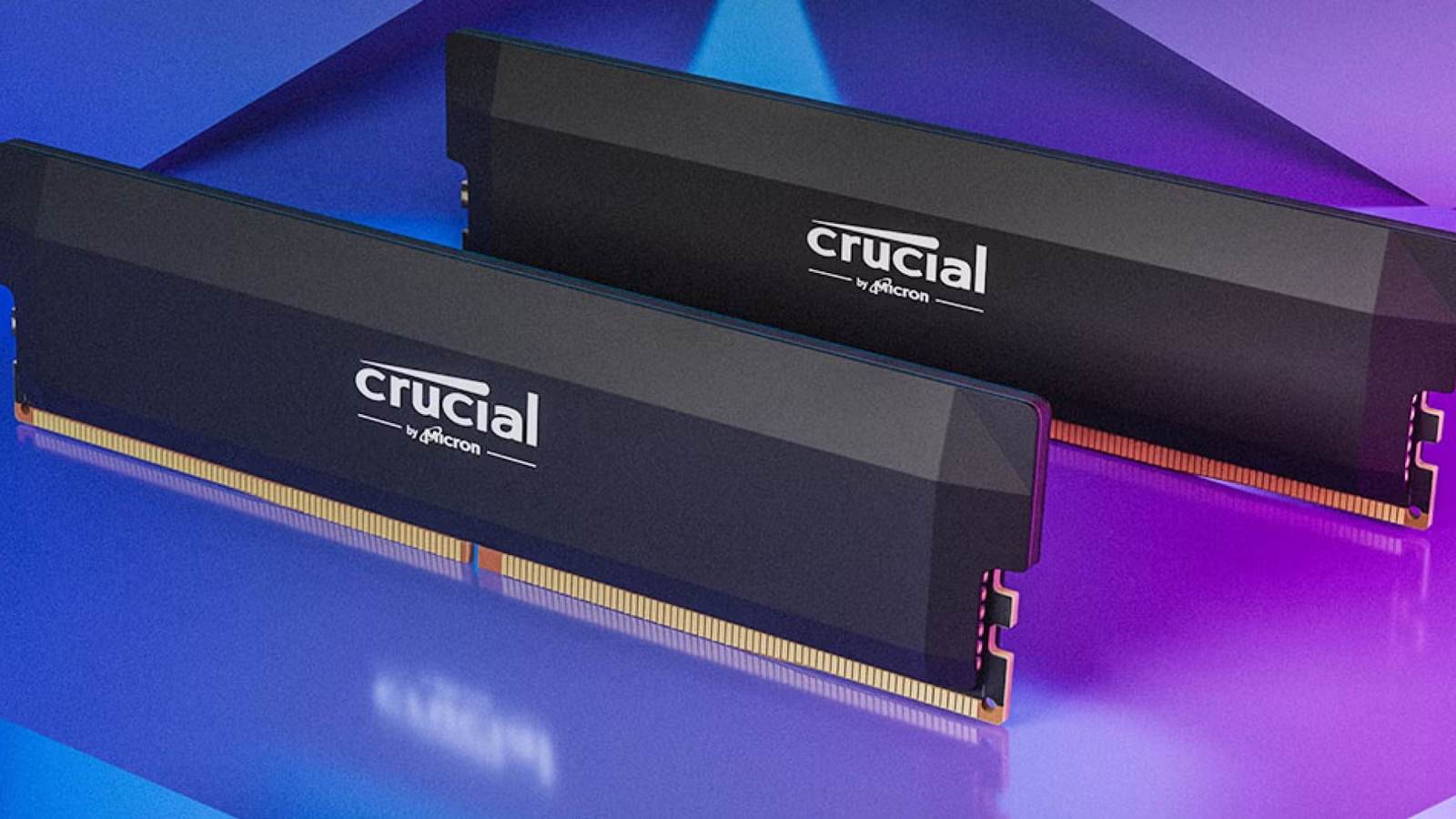
Imagine this: Six months ago, a 32GB kit of DDR5 RAM for your gaming rig cost about $120. Today, the same kit—identical specs, same brand—will set you back $350 or more, with stock vanishing faster than a viral meme. This isn’t hyperbole or a Black Friday glitch; it’s the new reality of the 2025 RAM shortage, a crisis rippling from Silicon Valley data centers to Akihabara electronics shops. What began as whispers of supply chain jitters has escalated into a full-blown “memory supercycle,” where artificial intelligence (AI) devours resources meant for everyday tech, leaving consumers, gamers, and industries scrambling.
In this deep dive, we’ll unpack the causes, crunch the numbers, trace the fallout, and peer into a future where relief feels as distant as Moore’s Law itself. Buckle up: the stats are staggering, and the implications? Even more so.
The Perfect Storm: Unraveling the Causes of the RAM Crunch
The RAM shortage isn’t a bolt from the blue—it’s the culmination of tectonic shifts in technology and economics. At its core lies the explosive growth of AI, which demands not just more memory, but better memory. High-Bandwidth Memory (HBM), the premium DRAM variant powering Nvidia’s GPUs and Google’s TPUs, requires complex, multi-layered chip stacks that gobble up silicon wafers like candy. Manufacturers, sensing the gold rush, have pivoted production lines away from commodity DRAM (the DDR4 and DDR5 in your laptop) toward HBM, creating a bottleneck for the masses.
Add to that a cocktail of geopolitical tensions, post-pandemic supply chain scars, and corporate caution. Factories take years to build, and after the 2022-2023 oversupply debacle, giants like Samsung and SK Hynix are loath to flood the market again. The result? Inventories have dwindled to razor-thin margins—DRAM stocks hovering at 2-4 weeks’ supply, down from 13-17 weeks just a year prior. Panic buying from OEMs (original equipment manufacturers) like Dell and Lenovo has only poured fuel on the fire, echoing the Great Toilet Paper Shortage of 2020 but with billion-dollar stakes.
But let’s not forget the human element: AI’s “black box” hunger. Training models like OpenAI’s GPT-5 or Anthropic’s Claude 3.5 requires servers stacked with terabytes of RAM, far outstripping consumer needs. As one analyst quipped, “AI isn’t just eating the world’s electricity—it’s devouring its memory too.”
By the Numbers: A Statistical Snapshot of the Shortage
To grasp the scale, consider the data. The global DRAM market, valued at around $100 billion annually, is in freefall from equilibrium. Here’s a breakdown of key metrics, drawn from industry forecasts and earnings reports:
| Metric | 2024 Baseline | 2025 Projection | Year-over-Year Change | Source Notes |
|---|---|---|---|---|
| Global DRAM Revenue | ~$95B (Q3 2024) | $124B (Q3 2025) | +30.9% QoQ; spot prices nearly triple YoY by Q4 | TrendForce; driven by HBM surge |
| HBM Market Size | $2.93B | $4.2B (est. end-2025) | CAGR 21.35% to 2033 ($16.72B total) | ResearchAndMarkets; 45% from data centers in USA alone (7.5M units consumed) |
| AI Data Center Market | $209B (semi total, 2024) | $236.44B (full market start-2025) | CAGR 31.6% to $933.76B by 2030 | MarketsandMarkets; semi growth to $492B by 2030 |
| DRAM Contract Price Hikes | +10-15% (Q3 2025) | +45-50% QoQ (Q4); up to 60% for some tiers | Samsung/SK Hynix leading; NAND wafers +60% in Nov | TrendForce, Reuters |
| Supply Shortfall | 13-17 weeks inventory | 2-4 weeks; ~70K wafer deficit for DDR4 by year-end | Normalization unlikely before 2027-2028 | TechInsights; all memory types (HDD, NAND, HBM) in “severe shortage” 2026 |
| Manufacturer Revenues | Micron CMBU: $4.2B (FY2024) | $13.52B (FY2025) | +257% YoY; SK Hynix DRAM share 33.2% (Q3) | Nasdaq; Samsung regains top spot |
These figures paint a picture of asymmetry: While HBM demand rockets—fueled by AI servers that can require 10x the memory of a high-end PC—commodity DRAM production has been deprioritized. SK Hynix, for instance, reported HBM sales eclipsing Samsung’s in Q2 2025, prompting a wafer reallocation that slashed DDR4 output by up to 20%. Micron, once a consumer darling via its Crucial brand, saw its market share climb 3.7 percentage points in Q3, but at the cost of exiting retail RAM entirely by 2026. TrendForce warns this “memory supercycle” could extend past 2028 if expansions remain cautious.
Zoom out, and the HBM IP market alone is barreling toward a $513 million valuation by 2032 at a blistering 28.4% CAGR, with servers claiming 55% share thanks to AI’s data-centric sprawl. It’s a tale of two markets: one feasting, the other famished.
The Human Cost: How the Shortage is Hammering Everyday Tech
The fallout isn’t confined to balance sheets—it’s hitting wallets and workflows worldwide. For gamers and PC enthusiasts, the pinch is acute. A mid-range build that cost $1,200 in early 2025 now balloons to $1,500+, with RAM accounting for 20-30% of the hike. DDR5 kits have doubled in price since summer, while DDR4—the “legacy” standard—now rivals DDR5 costs due to phase-out fears. Retailers like Newegg and Amazon report stockouts lasting weeks, and scalpers are circling eBay like vultures. One Redditor lamented, “I waited out the GPU shortage; now RAM is killing my upgrade dreams.”
Smartphones aren’t spared. Q4 DRAM contract prices have surged 25-30%, trickling into device bills by 20% on average come 2026 launches. Apple’s iPhone 17 and Samsung’s Galaxy S26 could see memory-induced price tags $100 higher, squeezing margins already thin from tariff wars. Automotive? Electric vehicles (EVs) rely on DRAM for ADAS (advanced driver-assistance systems) and infotainment; shortages have delayed production lines at Tesla and Ford by 10-15%, adding $500-1,000 per unit in costs.
Industrial sectors feel it deepest. Factories running on embedded systems face “RAM droughts” that halt assembly lines, with lead times stretching to 6-9 months. Even cloud providers like AWS are rationing instances, forcing SMBs (small-to-medium businesses) to downgrade from 64GB to 32GB configs—a 20-30% performance hit for data-heavy apps. As Jeff Geerling noted in his viral blog, “The RAM shortage comes for us all—if you’re not affected yet, just wait.”
Social media buzz underscores the frustration: X (formerly Twitter) threads overflow with memes of “AI stealing our RAM,” while gaming forums predict a “DIY death spiral” as builders pivot to consoles or wait it out.
Titans of the Trade: Manufacturers’ High-Stakes Gambit
Who bears responsibility? The “Big Three”—Samsung, SK Hynix, and Micron—control 95% of DRAM production, and their moves dictate the chaos. Samsung reclaimed the revenue crown in Q3 2025 with aggressive hikes of 40-60% on contracts, passing costs downstream while stockpiling for AI behemoths like Microsoft. SK Hynix, HBM’s undisputed king, boosted prices 30% in Q4 and curbed expansions to dodge oversupply ghosts. Micron’s pivot is brutal: Its data center business exploded 257% YoY, but it’s axing the consumer-focused Crucial line, effectively ceding retail ground.
Team Group, a key module maker, warns the crisis “has only just started,” with NAND (SSD memory) doubling in a month and DRAM following suit. Silicon Motion’s CEO called it unprecedented: “HDD, DRAM, HBM, NAND—all in severe shortage in 2026.” These firms aren’t villains; they’re rational actors in a market where HBM fetches 5-10x the margins of DDR5. Yet their caution—new fabs delayed to 2027—prolongs the pain.
Horizon of Hope? Projections and Pathways Forward
When does the drought end? Analysts are cautiously pessimistic. TrendForce eyes peak pricing in mid-2026, with stabilization by late 2027 as $20B+ in new capacity ramps up—provided no recessions or trade wars intervene. The rally could spill into 2028 if AI demand sustains its 30%+ CAGR. AI data centers, projected to hit $165.73B by 2034 at 28.34% growth, will keep the pressure on.
Optimists point to innovations: Next-gen HBM4 could ease bottlenecks by 2027, and diversified suppliers (e.g., China’s YMTC) might chip away at the oligopoly. For consumers, tips abound—hunt refurbished kits, delay upgrades, or embrace cloud gaming to sidestep local hardware woes. Policymakers? Subsidies for domestic fabs could accelerate relief, but that’s a 2026+ story.
The Bigger Picture: AI’s Double-Edged Sword
The 2025 RAM shortage is more than a tech hiccup—it’s a harbinger of our AI-saturated future. We’ve traded affordable gadgets for godlike computation, but at what cost? As prices soar 100-500% across modules, the digital divide widens: Gamers grind on decade-old rigs, EVs launch late, and startups choke on cloud bills. Yet, this crunch funds breakthroughs—faster LLMs, smarter cars, greener grids—that could pay dividends down the line.
In the end, the Great RAM Reckoning reminds us: Progress is voracious. As we navigate this squeeze, one truth holds: In the memory wars, we’re all collateral. Stock up wisely, build patiently, and remember—your next upgrade might just power the next revolution.