
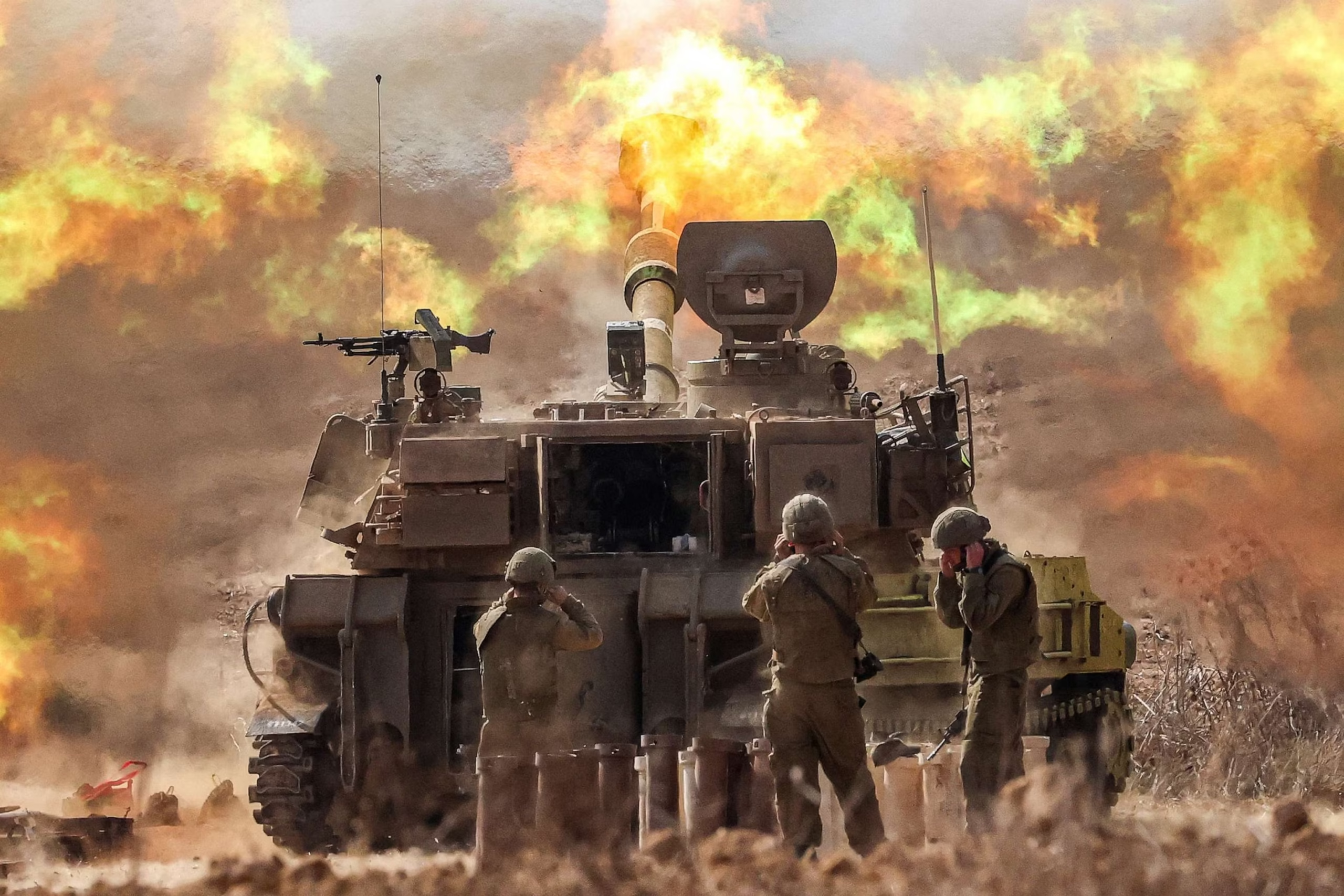
As the world navigates the final months of 2025, the scars of ongoing conflicts—from the grinding stalemate in Ukraine to the explosive escalations in the Middle East and the shadowy resource wars in Africa and Asia—continue to cast long shadows over global markets. What began as regional skirmishes have morphed into interconnected crises, amplifying inflation, disrupting supply chains, and driving investors toward safe havens. The Russia-Ukraine war, now in its fourth year, has compounded post-pandemic recovery woes, while the Israel-Hamas conflict and its spillover into the 12-day Iran-Israel war in June have spiked energy prices and heightened geopolitical risk (GPR). Meanwhile, civil wars in Sudan and Myanmar have turned commodities like gold into tools of war, fueling illicit economies that indirectly buoy global prices.
This article examines the multifaceted impacts of these wars on the global economy, gold, and cryptocurrency. Drawing on recent data, it reveals how these conflicts not only erode growth but also redefine asset classes: gold as the enduring safe haven, and crypto as a volatile bridge between risk and resilience. With global GDP growth projected at 3.2% for 2025—up slightly from earlier estimates but still below pre-conflict forecasts—these wars underscore a harsh truth: in an era of fragmentation, no economy is an island.
The Global Economic Toll: A Cascade of Disruptions
The economic fallout from these conflicts is both direct and insidious, manifesting in commodity shocks, trade barriers, and fiscal strains. The Russia-Ukraine war alone shaved about 1.5% off global GDP in 2022, with lingering effects pushing inflation up by 1.3 percentage points. By 2025, sanctions have isolated Russia, contracting its economy by an additional 2-3% annually, while Europe’s energy crisis—exacerbated by reduced Russian gas—has downgraded EU growth forecasts to around 1.2%. Food insecurity remains acute, with wheat prices 25-30% above pre-war levels, hitting emerging markets hardest and contributing to a 0.5% drag on global growth.
The Israel-Hamas war, entering its third year, has inflicted a 1.4% contraction on Israel’s GDP in Q2 2024, with Gaza’s economy shrinking 80% amid $50 billion in lost investments. Red Sea disruptions from Houthi attacks have added 20-30% to shipping costs, inflating global trade by 0.4-0.6% and risking a broader recession if oil breaches $100/barrel. The June 2025 Iran-Israel war—a 12-day frenzy of airstrikes and cyber operations—pushed Brent crude to $87/barrel, trimming 0.5% from global GDP and reigniting inflation fears in a tariff-laden world. Iran’s rial, already battered by sanctions, hit 1.2 million to the USD by December, eroding domestic purchasing power by 90% since 2018.
Less visible but no less damaging are the civil wars in Sudan and Myanmar. Sudan’s conflict has collapsed GDP by 12-18%, displacing 9 million and funneling $3.7 billion in smuggled gold to UAE refineries, embedding conflict minerals into global supply chains. This illicit trade sustains the war while inflating world gold prices by 1-2% through artificial scarcity. In Myanmar, post-2021 coup chaos has contracted GDP by 9% since 2020, with the kyat depreciating 240% to 4,520/USD and inflation at 25%. Garment exports—once 10% of GDP—fell 50%, while rare earth mining in rebel-held Shan State supplies 66% of China’s imports, distorting global tech supply chains amid environmental devastation.
Collectively, these wars compound a “polycrisis”: GPR indices are at decade highs, pushing recession odds to 61% and fragmenting trade into rival blocs, potentially costing 8.7% of global real income. Emerging markets face $100 billion in higher import bills, while advanced economies grapple with 1-2% inflation spikes from energy and food shocks. As one IMF analysis notes, these conflicts accelerate deglobalization, with indirect trade networks fraying under sanctions and blockades.
Gold: The Timeless Safe Haven in Turbulent Times
In an age of uncertainty, gold has reclaimed its throne as the ultimate hedge, its price trajectory a barometer of global anxiety. The Russia-Ukraine invasion ignited a 10% rally in early 2022, with prices hitting $2,051/oz amid safe-haven rushes and inflation fears. By late 2025, persistent tensions—coupled with central bank diversification—have sustained a 5-15% premium, with spot prices hovering at $4,200-4,250/oz. GPR spikes add a 2.5% return premium per 100-unit index rise, as seen during Ukraine’s wheat disruptions.
The Middle East maelstrom has supercharged demand. Post-October 2023 Hamas attacks, gold surged 44.8% to $2,653/oz, stabilizing 10-15% above pre-war levels by 2025. Iran’s June 2025 war triggered 1.3-1.7% spikes per escalation, peaking at $4,381/oz as the rial’s crash fueled domestic hoarding. Analysts forecast $4,000/oz by mid-2026 if tensions persist, with central banks like China’s and Russia’s adding 1,000+ tonnes annually to reserves.
Sudan’s war economy amplifies this: 60 tonnes smuggled yearly ($3.7 billion) fund the RSF and SAF, yet global output dips just 3-5%, keeping prices elevated without a crunch. Myanmar’s artisanal mining, disrupted by conflict, adds minor upward pressure (~1-2 tonnes illicit/year), but the real story is regional smuggling to China and Thailand. Overall, gold’s role as a diversifier shines: it hedges against crypto policy uncertainty (CPUI) and energy risks (ERUI), with positive short-term correlations to Bitcoin during wars. As one study concludes, “Gold acts as a strong safe haven against… natural gas in extreme market declines.”
Cryptocurrency: Volatility Amid Utility and Evasion
Crypto’s war-time performance is a tale of two assets: a risk-off casualty globally, yet a lifeline locally. The Russia-Ukraine war slashed Bitcoin trading volumes by 0.2-0.8% per 1% GPR rise, with initial dips of 4-6% post-invasion. Yet, Ukraine raised $54 million in donations, and Russia’s evasion via crypto—though limited by liquidity—spiked ruble-denominated volumes 270%. By 2025, returns show resilience in bullish phases but negative correlations in bearish ones, with Bitcoin acting as a weak hedge against wheat but not broader equities.
Middle East flares have been brutal: Bitcoin plunged 4% ($28,300 to $27,100) after October 2023 attacks, and 3-5% ($102,800 to $99,300) during Iran’s June war, with Ethereum/Solana down 7-10%. Network centrality fell amid GPR, but stablecoins like USDT gained for Gaza remittances and sanctions bypass. Iran’s Nobitex hack ($90 million loss) and 50-76% volume drops highlight cyber risks, yet outflows hit $4.18 billion in 2024 (+70% YoY) for capital flight.
In Sudan and Myanmar, crypto’s role is nascent but potent. Sudan’s chaos limits adoption, but regional outflows rose 10-15% for aid evasion. Myanmar’s NUG tokenized the kyat as Digital Myanmar Kyat (DMMK) on Stellar, facilitating $500 million in transactions by March 2025 for remittances and war funding—volumes up 200-300% post-coup. Despite junta bans, it’s a “digital resistance” tool, with user penetration at 2.4% and market revenue at $40.2 million. Globally, crypto’s war-era volatility—dipping 3% on average per escalation—contrasts its utility, but correlations with gold are rising, positioning it as “digital gold” in select crises.
Comparative Snapshot: Wars, Assets, and the Road Ahead
To distill the chaos:
| Conflict | Global GDP Impact (2025 Est.) | Gold Price Effect | Crypto Volatility/Utility |
|---|---|---|---|
| Russia-Ukraine | -0.5% (energy/food shocks) | +10% rally; sustained $4,200+ premium | -0.2-0.8% volume drop; $54M Ukraine aid |
| Israel-Hamas/Iran | -0.5-1% (oil/shipping) | +44.8% surge; $4,381 peaks | 3-10% dips; stablecoins for evasion |
| Sudan Civil War | -0.1-0.2% (refugee/commodity) | +1-2% via smuggling; local +20-30% | +10-15% regional outflows |
| Myanmar Civil War | -0.2% (rare earths/garments) | Minor smuggling pressure | +200-300% volumes; DMMK for resistance |
These wars, intertwined with U.S.-led tariffs, herald a fragmented 2026: expect 1% U.S. GDP hits, 2-3% wage declines, and persistent volatility. Gold’s allure endures, but crypto’s hybrid role—hedge in theory, haven in practice—could redefine resilience. Policymakers must prioritize de-escalation; absent that, the global economy risks a permanent scar. As conflicts rage, one lesson rings clear: in war’s forge, assets are tested, and only the durable prevail.