
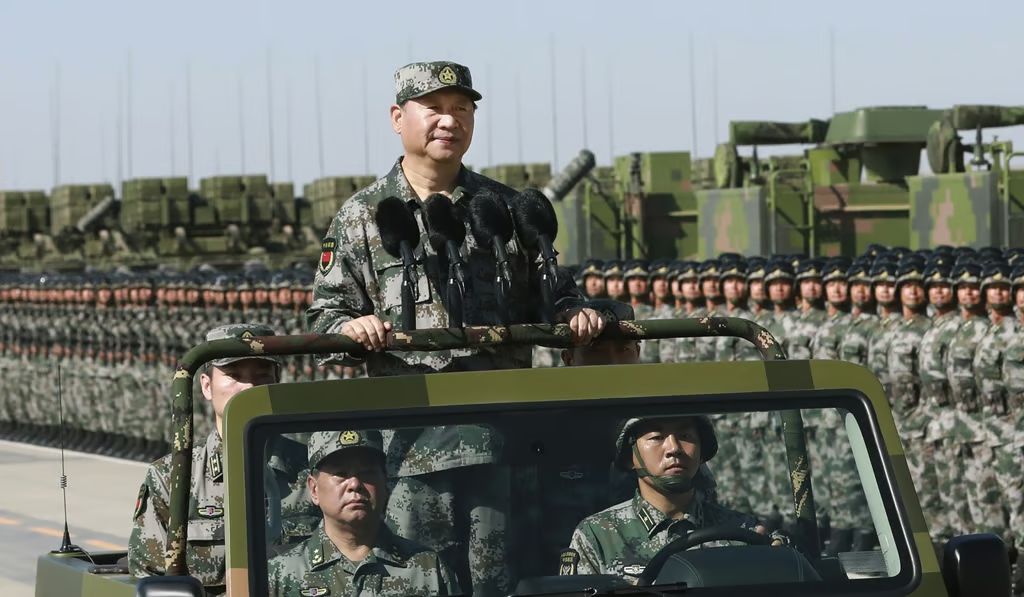
In a significant development amid one of the most intense anti-corruption campaigns in the People’s Liberation Army (PLA)’s history, Chinese President Xi Jinping has appointed new commanders to two of the PLA’s five theater commands: the Eastern Theater Command and the Central Theater Command. On December 22, 2025, Xi promoted Lieutenant General Yang Zhibin to full general and named him commander of the Eastern Theater Command, while General Han Shengyan was similarly promoted and appointed to lead the Central Theater Command.
These appointments come on the heels of a sweeping purge that has removed dozens of senior officers in 2025, including high-profile figures like former Central Military Commission (CMC) Vice Chairman General He Weidong and former Eastern Theater Command commander General Lin Xiangyang. The reshuffle underscores Xi’s relentless drive to ensure absolute loyalty and combat readiness in the PLA, particularly in commands vital to China’s core security interests.
The New Appointments: Stabilizing Key Commands
The Eastern Theater Command, headquartered in Nanjing, is arguably the PLA’s most operationally critical formation. It oversees military activities in the East China Sea, the Taiwan Strait, and disputed areas with Japan, making it the primary command responsible for any potential operations involving Taiwan reunification—a core priority for Xi Jinping.
- New Commander: General Yang Zhibin (Air Force background, aged 62). Yang, a relative newcomer to the command, has been positioned as its leader following the disappearance and subsequent expulsion of his predecessor, Lin Xiangyang, on corruption charges.
- Analysts note that Yang’s appointment, alongside possible political commissar changes, aims to restore operational continuity in a command hit hard by corruption scandals.
The Central Theater Command, based in Beijing, focuses on defending the capital and surrounding regions. It serves as a strategic reserve, providing reinforcements, logistics, and training support to other theaters.
- New Commander: General Han Shengyan. This appointment ensures stability in the command responsible for safeguarding the political heart of China.
These changes were formalized in a ceremony where Xi presented certificates of promotion, signaling his direct oversight as CMC Chairman.
Historical Background: From Military Regions to Theater Commands
The PLA’s current structure traces its roots to major reforms initiated by Xi Jinping in 2015-2016, aimed at transforming a ground-force-dominated military into a modern, joint operations-capable force.
Prior to 2016, the PLA was organized into seven military regions (Beijing, Nanjing, Guangzhou, Lanzhou, Chengdu, Jinan, and Shenyang), which combined administrative, logistical, and operational functions. These regions were often criticized for inefficiencies, corruption, and a lack of joint interoperability between army, navy, air force, and rocket forces.
In a landmark overhaul announced at the Third Plenary Session of the 18th Central Committee in 2013 and implemented in 2016, Xi restructured the PLA into five theater commands: Eastern, Southern, Western, Northern, and Central. This shift emphasized:
- Joint operations: Theater commands now integrate all services under unified leadership for wartime scenarios.
- Party control: Strengthened CMC authority, with Xi as chairman, to ensure absolute loyalty.
- Geographic focus: Each command aligns with strategic directions (e.g., Eastern for Taiwan/East China Sea; Central for capital defense).
This reform drew inspiration from U.S. combatant commands but retained strong Communist Party oversight through political commissars.
Xi’s Anti-Corruption Campaign in the PLA: A Decade of Purges
Xi’s military reforms have been accompanied by an unrelenting anti-corruption drive, often described as the most extensive in PLA history.
- Early Phase (2012-2017): Targeted legacies from previous eras, including CMC Vice Chairmen Xu Caihou and Guo Boxiong, accused of selling promotions. This “killing the monkeys to scare the chickens” approach eliminated entrenched factions.
- Rocket Force Focus (2023-2024): Purges hit the strategic missile forces hard, removing commanders over equipment procurement scandals.
- 2025 Escalation: The most dramatic wave yet. In October 2025, nine senior generals were expelled from the Party and military, including:
- He Weidong (former CMC Vice Chairman and Politburo member, once seen as Xi’s close ally).
- Miao Hua (former Political Work Department director).
- Lin Xiangyang (former Eastern Theater commander).
Charges included corruption, disloyalty, and undermining Party control over the military.
Many purged officers shared ties to the former 31st Group Army (Fujian-based), highlighting networks of patronage. The campaign has removed over 50 top generals since 2014, raising questions about systemic corruption even among Xi’s appointees.
Analysts view these purges as dual-purpose: rooting out graft while consolidating Xi’s personal control. However, they have disrupted command stability, potentially affecting readiness in sensitive areas like Taiwan operations.
Implications for China’s Military Posture
The appointments of Yang Zhibin and Han Shengyan signal Xi’s intent to stabilize the PLA after the 2025 purges. With the Eastern Theater Command directly involved in frequent drills around Taiwan and the Central Command guarding Beijing, loyal and capable leadership is crucial amid rising tensions in the Indo-Pacific.
Yet, the unprecedented scale of removals—including sitting CMC members—suggests deep-seated issues. Xi’s campaign reinforces the Maoist principle that “the Party commands the gun,” but at the cost of institutional trust and operational experience.
As China navigates geopolitical challenges, these changes reflect Xi’s determination to forge a “world-class” military by 2049—one that is politically pure, corruption-free, and unwaveringly loyal to him.
This reshuffle may mark a turning point, but given the pattern of Xi’s rule, further changes could follow as the anti-corruption drive continues.