
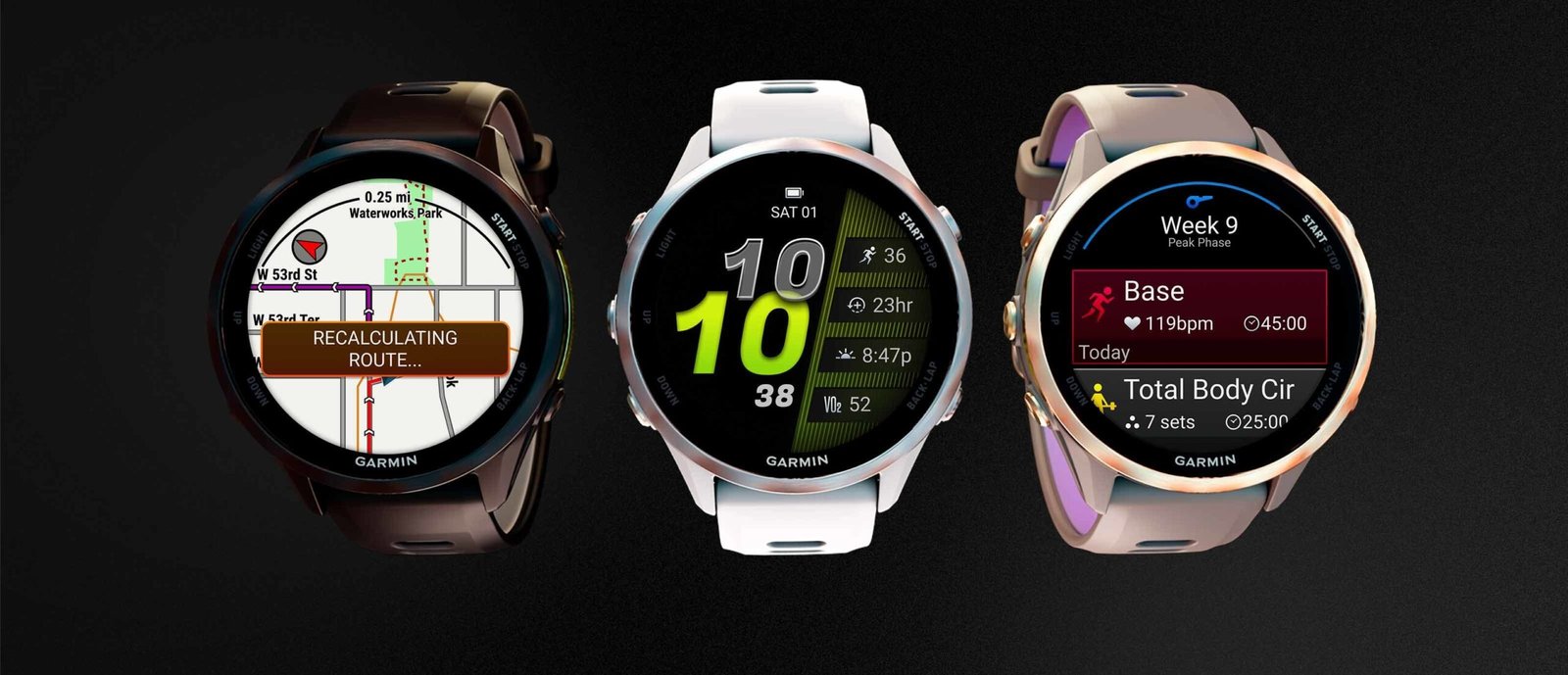
The Garmin Forerunner 970, launched in May 2025 as the successor to the acclaimed Forerunner 965, is Garmin’s flagship GPS running and triathlon smartwatch. Priced at $749.99, it builds on its predecessor by incorporating hardware upgrades from the Fenix 8 series (like a speaker/mic and LED flashlight) while introducing new athlete-focused metrics and a brighter AMOLED display. After months of real-world use and cross-referencing expert reviews from DC Rainmaker, Runner’s World, and others, it’s clear this is one of the most capable multisport watches ever made—though the premium price and some trade-offs will polarize buyers.
Design and Build
The 970 sticks to a single 47mm case size with a lightweight fiber-reinforced polymer body and titanium bezel, now paired with a sapphire crystal lens for superior scratch resistance (a big upgrade from the 965’s Gorilla Glass). It’s slightly thinner than the 965 and incredibly comfortable for 24/7 wear, even during sleep tracking. Color options include sleek combos like Carbon Gray DLC Titanium with Black case or Soft Gold with French Gray band.
The five-button layout plus responsive touchscreen remains intuitive, with customizable controls. A standout addition: the built-in LED flashlight (white and red modes) for low-light safety—borrowed from the Fenix line and a genuine game-changer for dawn/dusk runs.
Display
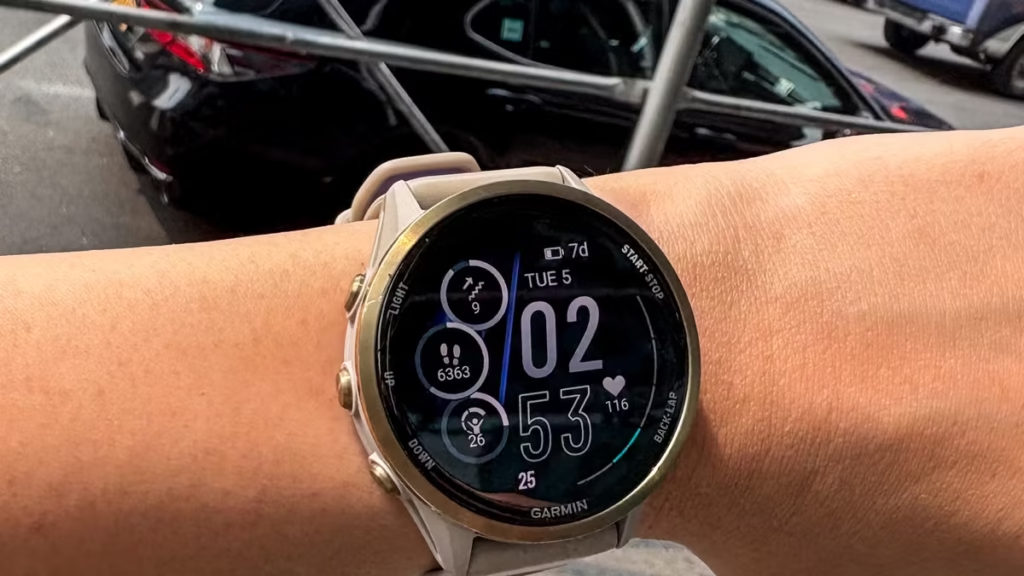
Garmin touts this as their brightest AMOLED yet (1.4-inch, 454×454 resolution), and it delivers. Visibility in direct sunlight is excellent, with vibrant colors and sharp maps/notifications. Compared to the 965, the boost in brightness is noticeable, though it contributes to slightly reduced battery in always-on mode. Touch response is smooth, but some users note minor lag in scrolling—common across Garmin’s UI.
Sensors and Accuracy
Equipped with the Elevate Gen 5 optical HR sensor, multi-band GPS with SatIQ, ECG (for AFib detection), skin temperature, and pulse ox. GPS accuracy is top-tier: DC Rainmaker and Runner’s World praise its performance in urban and trail scenarios, often matching or beating competitors. HR is reliable for steady-state efforts but can lag in HIIT without a strap (pair with the new HRM-600 for advanced metrics).
Training Features and Metrics
This is the 970’s stronghold for serious athletes:
- New Metrics: Running Tolerance (load your body can handle), Running Economy, Step Speed Loss—data-driven insights requiring the HRM-600 strap for full depth.
- Garmin Coach: Adaptive plans for running, cycling, strength, and now triathlon-specific.
- Multisport: Auto-transitions, custom brick workouts, triathlon profiles—making it the most complete tri watch Garmin has produced.
- Reports: Morning Report plus new Evening Report (sleep needs, tomorrow’s workout preview).
- Navigation: Full-color topo maps, turn-by-turn, ClimbPro, dynamic route recalculation.
Health tracking shines with accurate sleep staging, HRV status, Body Battery, and Training Readiness.
Smart Features
Speaker and mic enable Bluetooth calls and voice assistants. Offline music (Spotify/Deezer/Amazon), Garmin Pay, notifications, and incident detection add daily utility—pushing it closer to a true smartwatch than prior Forerunners.
Battery Life
A common critique: Smartwatch mode up to 15 days (down from 23 on the 965 due to brighter screen). GPS modes are strong (up to 31 hours multi-band), and real-world tests show a week+ with moderate use. Manageable for most, but heavy map/music users will charge more often.
Pros and Cons
Pros:
- Unmatched depth for running/triathlon training
- Brightest, most durable display in the series
- Excellent GPS/HR accuracy
- Practical additions like flashlight, calls, ECG
- Comprehensive maps and navigation
- Lightweight and comfortable
Cons:
- Expensive ($750, +$150 over 965)
- Some advanced metrics need extra $170 HRM-600
- Shorter smartwatch battery than predecessor
- Single size may be large for smaller wrists
- Occasional early software glitches (mostly fixed via updates)
- UI lag in some menus
Competitors Comparison
In a stacked 2025 market, the 970 excels in athletic depth but faces value challengers:
- Coros Pace Pro (~$499): Insane battery, accurate tracking, but fewer metrics/smart features.
- Polar Vantage V3 (~$600): Superior recovery focus, lighter price, polished but less expansive ecosystem.
- Apple Watch Ultra 3 (~$799): Best smart integration (iOS only), shorter battery, shallower training tools.
- Suunto Race 2 (~$549): Great value with maps, rugged, but metrics lag Garmin.
- Garmin Fenix 8 (~$999+): More durable/battery, but bulkier and pricier—970 is the “lighter Fenix” for runners.
Final thought
The Garmin Forerunner 970 is a brilliant evolution—refined, powerful, and the benchmark for dedicated runners and triathletes in late 2025. It bridges the gap to the Fenix while staying wrist-friendly, earning consistent praise for accuracy and features. If you’re upgrading from a 965 or older, the brighter screen, flashlight, new metrics, and tri tools make it worthwhile for power users. Casual athletes might prefer the cheaper Forerunner 570 or competitors for better value/battery.
At its core, no watch matches Garmin’s data ecosystem for performance-driven training. Highly recommended if budget allows—it’s the watch serious athletes have been waiting for.