

As 2025 draws to a close on December 30, the crypto world is buzzing with a paradoxical story from Ethereum. While ETH’s price has stumbled through a rough quarter – dropping around 27-29% to hover near $2,900-$3,000 – the network beneath it is thriving like never before. According to on-chain analytics firm Token Terminal, Ethereum’s base layer (L1) saw a staggering 8.7 million new smart contracts deployed in Q4 alone. This isn’t just a new high; it’s an all-time record that shatters previous peaks and signals a profound shift in how the world’s leading smart contract platform is evolving.
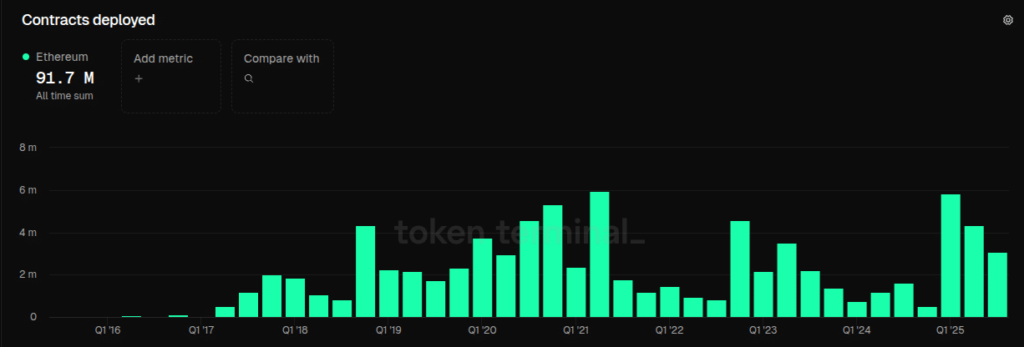
This chart from Token Terminal captures the dramatic surge: after a downward trend through much of 2025 (from ~6 million in Q1 to just 3.1 million in Q3), deployments exploded in the final quarter, dwarfing even the network’s most active historical periods.
From Rock Bottom to Record High: The Rollercoaster of 2025
To appreciate the magnitude, consider the contrast with recent history. Just one year earlier, in Q4 2024, Ethereum hit its lowest quarterly deployments since 2017 – a mere 528,100 contracts. That period reflected broader crypto winter blues: post-FTX fallout, regulatory uncertainty, and waning retail hype.
Fast forward to 2025, and the narrative flips. Total lifetime contracts on Ethereum now exceed 91.7 million. Analysts like Joseph Young describe this Q4 surge as “organic growth” that’s “hard to inflate.” Why? Smart contract deployments serve as a pure proxy for genuine developer activity – new apps, infrastructure, tokens, and protocols launching on-chain.
Yet, this boom occurred amid price pain. ETH failed to hold above $3,000 for much of the quarter, weighed down by selling pressure and failure to break key resistances. As of late December, it’s trading around $2,980-$3,019, down sharply from summer highs near $5,000. This divergence – fundamentals soaring while price lags – has become a hallmark of Ethereum’s maturation.
The Engines Driving the Surge
What fueled this explosion? Three interconnected forces stand out:
- Real-World Asset (RWA) Tokenization Takes Center Stage
Ethereum has solidified its position as the “institutional standard” for bringing traditional assets on-chain. From tokenized U.S. Treasuries (dominated by funds like BlackRock’s BUIDL) to private credit, real estate, and corporate bonds, RWAs exploded in 2025. Excluding stablecoins, tokenized RWAs reached ~$18-23 billion globally, with Ethereum hosting the lion’s share (~$12.3 billion per RWA.xyz data).
Institutions favor Ethereum’s security, liquidity, and established tools. Each new tokenized asset requires smart contracts for issuance, compliance, and management – directly contributing to the deployment spike. - Stablecoin Renaissance
Stablecoins – the “killer app” for on-chain finance – saw massive growth, with market cap climbing toward $300+ billion. Ethereum remains the primary hub, supporting issuers like Tether (USDT) and Circle (USDC). New stablecoin deployments, yield-bearing variants, and integrations with DeFi protocols added thousands of contracts. - Infrastructure and Ecosystem Build-Out
Even as Layer 2 (L2) solutions like Arbitrum and Optimism handle most user activity, the base layer remains the settlement hub. Developers are deploying contracts for wallets, intents-based systems, rollup bridges, and institutional-grade tools. Vitalik Buterin himself noted that building directly on L1 has become “easy” – anyone can deploy with minimal friction.
ETH ETF approvals earlier in the year boosted institutional inflows, indirectly fueling development. Active addresses surged, and the 30-day moving average for new contracts hit 171,000 – another bullish indicator.
Why Price and Fundamentals Are Decoupling – And Why It Matters
In crypto’s early days, hype drove everything. Today, Ethereum’s record activity amid a price dip highlights a shift toward real utility. On-chain economic value (~$330 billion) now closely tracks market cap (~$350-360 billion), per analysts. Institutional accumulation continues quietly, with exchange reserves falling and staking hitting new highs (over 32 million ETH staked).
Critics point to L2 fragmentation diluting L1 metrics, but Token Terminal tracks base-layer deployments separately – and the surge is undeniable. This “hard-to-fake” signal suggests builders are betting big on Ethereum’s long-term dominance in tokenized finance.
Looking Ahead: Bullish Foundations for 2026?
As we enter 2026, this Q4 record could be the foundation for Ethereum’s next leg up. Forecasts suggest stablecoins could hit $500 billion and RWAs $300 billion, potentially exploding Ethereum’s TVL 10x. Regulatory clarity, further ETF maturation, and macro tailwinds (like rate cuts) could bridge the price-fundamentals gap.
Ethereum isn’t flashing neon hype anymore – it’s quietly becoming the backbone of a tokenized world. The 8.7 million contracts of Q4 2025 aren’t just numbers; they’re a testament to resilience, innovation, and the unyielding march of builders in the shadows of a bearish market.
In the words of one analyst: This is the calm before the institutional storm. Ethereum’s silent boom may soon roar.