
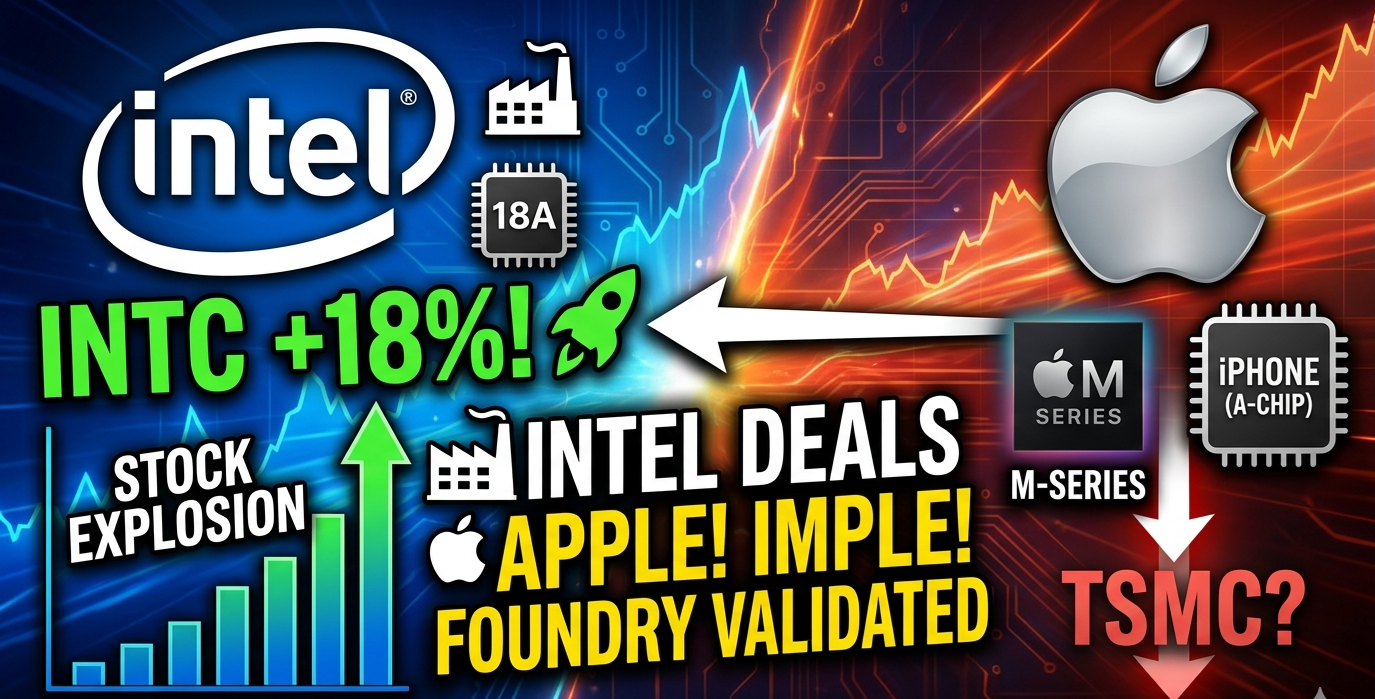
The financial world witnessed a tectonic shift on May 8, 2026, as Intel Corporation (INTC) orchestrated one of the most significant single-day rallies in the history of the semiconductor industry. By midday, Intel shares had rocketed an astonishing 18%, a move that added tens of billions of dollars in market value and sent a clear signal to Silicon Valley and beyond: the king of American silicon is back.
The catalyst for this historic surge was a bombshell report from the Wall Street Journal, later corroborated by Bloomberg, revealing that Apple Inc. has reached a preliminary agreement with Intel Foundry. Under the terms of this landmark deal, Intel will manufacture future generations of Apple’s M-series processors—the brains behind the Mac and iPad—and potentially the A-series chips that power the iPhone.
For Intel, this is more than just a contract; it is a total vindication of a multi-year, high-stakes gamble to reinvent the company.
The “Seal of Approval” That Changed Everything
To understand why an 18% jump is justified, one must look at the psychological weight of Apple as a customer. For nearly a decade, Apple has been the “anchor tenant” at TSMC (Taiwan Semiconductor Manufacturing Company). Apple is notoriously the most demanding client in the world, requiring the highest yields, the most advanced transistor density, and flawless execution.
By choosing Intel’s 18A (1.8nm) manufacturing node, Apple has effectively given Intel the ultimate “stamp of approval.” For years, critics and short-sellers argued that Intel had lost its “process leadership” and would never catch up to TSMC’s miniaturization capabilities. Today’s news renders those arguments obsolete. If the 18A node is good enough to meet Apple’s obsessive standards for the MacBook and iPhone, it is officially world-class.
Why Intel Soared: The Financial Breakdown
The market’s reaction was violent and immediate. Intel’s stock price, which had been steadily recovering throughout 2025, smashed through the $115 resistance level, reaching heights not seen in years. Analysts point to three primary financial drivers behind the +18% move:
- Guaranteed High-Margin Volume: Intel’s “mega-fabs” in Ohio and Arizona are massive capital expenditures. To be profitable, they need to run at near-maximum capacity. Securing Apple—a company that sells hundreds of millions of devices annually—guarantees that Intel’s machinery will never sit idle.
- The “Foundry Flywheel”: Now that Apple is on board, other “fabless” giants like Nvidia, AMD, and Qualcomm are under immense pressure to reconsider Intel Foundry. This deal creates a “flywheel effect” where Intel’s increased scale leads to better yields, which leads to more customers.
- Short Covering: Given Intel’s struggles in the early 2020s, the stock remained a favorite target for short-sellers. The Apple news acted as a massive “short squeeze,” forcing bearish investors to buy back shares at any price to cover their positions.
| Metric | Pre-Announcement (Estimated) | Post-Announcement (May 8, 2026) |
| Stock Price | $97.50 | $115.05 (+18%) |
| Market Cap | ~$530 Billion | ~$630 Billion |
| P/E Ratio | 22.4 | 26.5 |
The “TSMC Hedge”: Apple’s Strategic Masterstroke
While the market is celebrating Intel, this move is equally important for Apple. For years, Tim Cook has faced mounting pressure regarding Apple’s over-reliance on Taiwan. With geopolitical tensions remaining a constant variable, Apple’s supply chain was vulnerable.
By shifting production to Intel’s domestic U.S. plants, Apple achieves geopolitical diversification. They are no longer beholden to a single geographic point of failure. This “TSMC Hedge” allows Apple to market its products as being “Made in America” (or at least “Silicon Made in America”), a move that carries significant political and brand weight in 2026.
Furthermore, Intel’s PowerVia (backside power delivery) technology is rumored to have been a major technical clincher for Apple. By delivering power from the back of the wafer rather than the front, Intel has solved a major “bottleneck” in chip design, allowing for cooler, faster, and more efficient M-series chips than anything currently on the market.
The Architect of the Turnaround: Lip-Bu Tan
Much of the credit for today’s surge is being directed at Intel’s leadership. Since taking the helm, CEO Lip-Bu Tan has pivoted the company away from its fragmented past and toward a singular, obsessive focus on “Foundry First.”
Tan’s strategy involved a “culture of transparency” and a willingness to admit Intel’s past failures. By inviting the U.S. government to take a ~10% stake in the company in 2025, he secured the necessary capital to build out infrastructure that was “too big to fail.” Today’s Apple deal is the crowning achievement of that partnership between private industry and national interest.
Broader Market Impact: A New Semiconductor Hierarchy
The ripple effects of the Intel-Apple deal are being felt across the entire S&P 500.
- TSMC (TSM): Shares fell roughly 4% on the news. While TSMC remains the largest foundry in the world, the loss of its “monopoly” on Apple’s high-end business is a significant blow to its long-term growth projections.
- Samsung Electronics: Samsung, which had been vying to be the “second source” for Apple, saw its stock dip as it became clear that Intel has leapfrogged them in the race for 2nm-class dominance.
- ASML: The maker of the lithography machines Intel uses saw its stock rise, as the deal confirms a massive, ongoing demand for High-NA EUV equipment in the United States.
Challenges and the Road Ahead
Despite the euphoria, seasoned investors are keeping a close eye on execution risk. The agreement is currently “preliminary,” meaning the technical integration of Apple’s designs into Intel’s 18A process is just beginning.
Intel must now prove it can maintain high yields (the percentage of functional chips per wafer) at scale. If Intel hits a production snag in 2027, the “Apple premium” currently baked into the stock price could evaporate as quickly as it appeared. However, with Intel’s reported yields already exceeding 60% for advanced nodes, the mood on the street is overwhelmingly optimistic.
Conclusion: The Dawn of a New Era
The +18% surge in Intel stock isn’t just a “good day” for the company—it’s a paradigm shift. It marks the end of the era where American chip manufacturing was seen as a relic of the past and the beginning of a new chapter where Intel is a legitimate rival to the Asian foundry giants.
For investors, the Apple-Intel deal is the ultimate “buy” signal for a company that has finally aligned its massive engineering talent with a clear, profitable, and strategically vital mission. As the closing bell rings on May 8, 2026, Intel isn’t just a chipmaker anymore; it is the backbone of the Western high-tech economy.