
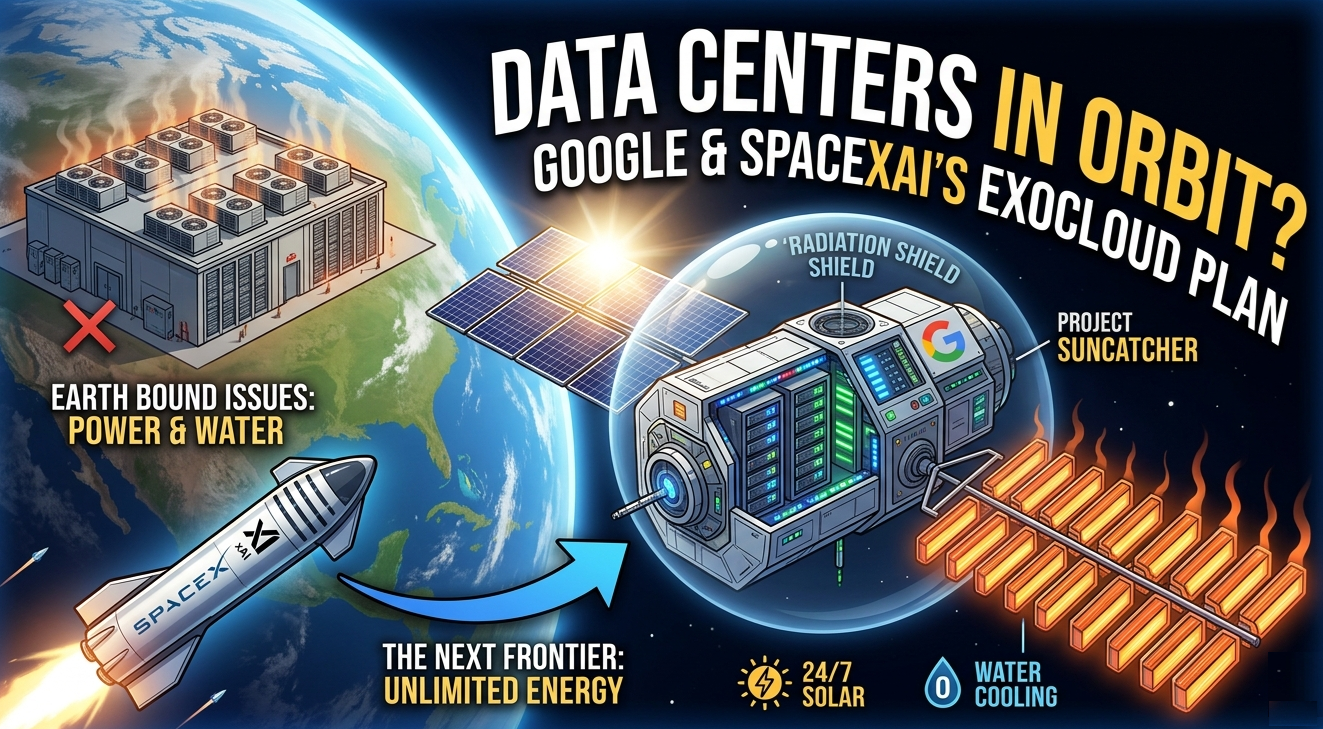
For years, we’ve used the term “The Cloud” to describe a very grounded reality: massive, windowless warehouses in places like Iowa or Finland, packed with servers and consuming enough electricity to power small cities. But as of 2026, the metaphor is becoming literal.
The tech world is buzzing over negotiations between Google and SpaceXAI (the powerhouse formed by the SpaceX and xAI merger) to launch Project Suncatcher. The goal? Moving the world’s most demanding AI workloads off-planet. It sounds like the plot of a high-budget sci-fi thriller, but the logic behind it is surprisingly down-to-earth.
The “AI Power Wall”: Why Earth is Running Out of Room
The demand for artificial intelligence has grown so fast that it’s hitting a physical ceiling. We are currently facing what engineers call the “AI Power Wall.” To train the next generation of models, we need more energy and more cooling than the Earth’s current infrastructure can comfortably provide.
The Problem with Terrestrial Data Centers
| Feature | The Earthly Challenge | The Orbital Opportunity |
| Power | Grids are saturated; new plants take a decade to build. | 24/7 Solar energy without atmospheric interference. |
| Cooling | Consumes billions of gallons of fresh water. | Heat is radiated into the vacuum (zero water used). |
| Real Estate | Massive land footprints and “NIMBY” legal battles. | Infinite space in Low Earth Orbit (LEO). |
| Regulation | Years of environmental and local permitting. | Governed by federal and international space law. |
Project Suncatcher: Google’s Orbital Brain
Google isn’t just sending off-the-shelf computers into space. Project Suncatcher is designed around their custom Tensor Processing Units (TPUs). These chips are the specialized “brains” behind Google’s AI, and they are notoriously power-hungry.
By placing these TPUs in orbit, Google can tap into solar energy that is roughly five times more intense than what reaches the ground. In LEO, a satellite is in direct sunlight the vast majority of the time. There are no clouds, no smog, and no “night” in the traditional sense. It is a pure, unadulterated stream of clean energy.
The SpaceX Factor: Making it Affordable
Ten years ago, the cost of launching a data center into space would have been laughable. However, the 2026 landscape is different. SpaceXAI has revolutionized the economics of space through two key pillars:
- Starship: The world’s first fully reusable heavy-lift rocket has dropped launch costs from thousands of dollars per kilogram to nearly $100/kg. It can carry entire “server racks” in its massive cargo bay.
- Starlink Laser Backbone: SpaceX already has a web of thousands of satellites communicating via lasers. This provides the high-speed “internet pipes” needed to move massive amounts of data from Earth to the orbital data centers and back.
The Reality Check: The Engineering Nightmares
If putting data centers in space were easy, we would have done it already. The “Exo-Cloud” faces three massive technical hurdles that Google and SpaceX engineers are currently trying to solve.
1. The Thermal Paradox
Space is famously cold (-270°C), but paradoxically, cooling a computer in space is much harder than on Earth. On Earth, we use fans to move air over hot chips. In a vacuum, there is no air to move.
- The Struggle: Heat must be converted into infrared light and “radiated” away.
- The Solution: Suncatcher satellites require massive, foldable radiator wings—some the size of a tennis court—just to keep a small cluster of chips from melting themselves.
2. The Radiation “Bit-Flip”
Outside the Earth’s protective atmosphere, computers are pelted by high-energy cosmic rays. When one of these rays hits a chip, it can flip a 0 to a 1 (a “Single Event Upset”).
- The Risk: In AI training, a few flipped bits can “poison” the entire model, making the AI hallucinate or fail.
- The Shield: Google is developing “software-redundancy,” where multiple chips perform the same calculation and “vote” on the correct answer to filter out radiation errors.
3. The Maintenance Gap
If a server fails in a Google data center in Oregon, a technician swaps it out in ten minutes. If a TPU fails in orbit, you can’t send a repair crew.
- The Strategy: These satellites must be “gracefully degradable.” They are built with massive amounts of backup hardware so they can stay operational even after multiple internal failures.
Geopolitics: Data Havens in the Stars?
Beyond the engineering, there is a legal frontier. Moving data centers to orbit creates a “Data Sovereignty” gray area. If a data center is floating 500 miles above the Earth, which country’s laws apply to the data inside?
- Can Google bypass EU privacy laws?
- Can they avoid national AI safety regulations?The “Exo-Cloud” could potentially become the first “Data Haven,” existing outside the jurisdiction of any single nation-state.
Conclusion: The Dawn of the Celestial Economy
The talks between Google and SpaceX represent a turning point in human history. We are moving from using space for communication (GPS, TV) to using space for production—specifically, the production of intelligence.
While the challenges of heat, radiation, and cost are immense, the pressure of the AI Power Wall makes the transition inevitable. The “Cloud” is finally heading where it belongs: among the stars.