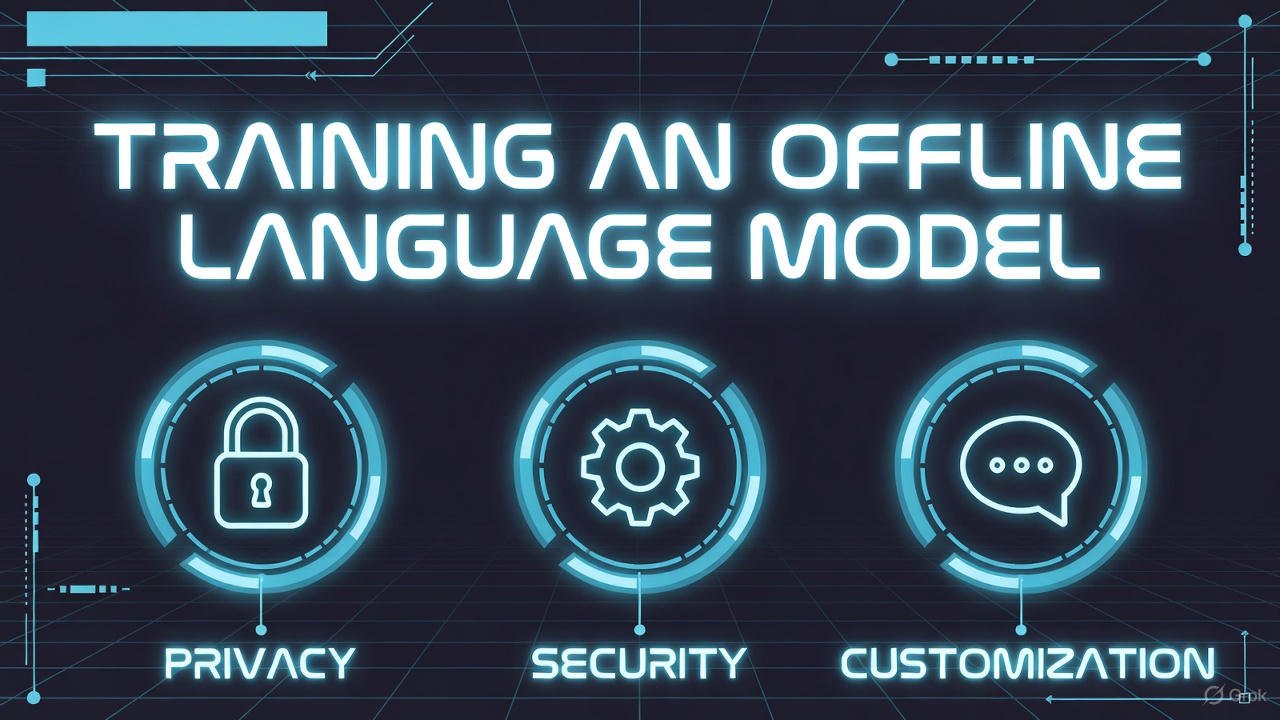
In an era dominated by cloud-based giants like ChatGPT and Gemini, the idea of training your own language model—and running it entirely offline—might sound like a relic from the dial-up days. But here’s the twist: offline language models (LMs) are surging in popularity among developers, researchers, privacy advocates, and everyday users. These models are trained once on local hardware (or rented compute) and then deployed on your laptop, phone, or edge device without ever phoning home to a server.
Why bother? Training an offline LM isn’t just about going rogue against Big Tech—it’s about reclaiming control in a world where AI is ubiquitous but opaque. From safeguarding your data to slashing costs and enabling seamless use in the wild, the benefits are transformative. In this article, we’ll dive into the compelling reasons to roll up your sleeves and train one yourself.
1. Unmatched Privacy: Keep Your Data Where It Belongs
The Achilles’ heel of online LMs? Your data isn’t yours. Every query you send to a cloud service gets logged, analyzed, and potentially monetized. Sensitive info—like medical histories, legal documents, or proprietary code—becomes fodder for training datasets or targeted ads.
Offline models flip the script:
- Zero data transmission: Train on your local dataset, infer locally. No queries leave your device.
- Compliance made easy: Perfect for GDPR, HIPAA, or enterprise regulations where data sovereignty is non-negotiable.
- Real-world example: Journalists or activists in censored regions use offline LMs to analyze documents without risking surveillance.
Tools like Hugging Face’s Transformers library or Ollama make it feasible to fine-tune models like Llama 3 or Mistral on personal hardware, ensuring your whispers stay whispers.
2. Ironclad Security: Fortify Against Breaches and Exploits
Cloud outages? API key leaks? Nation-state hacks? Online LMs are sitting ducks. Remember the 2023 MOVEit breach exposing millions, or the countless API vulnerabilities in AI services?
Offline training and deployment offer:
- Air-gapped operation: Run in isolated environments, immune to remote attacks.
- Custom hardening: Embed security features like encrypted weights or tamper-proof inference.
- Supply chain trust: You control the entire pipeline—from data curation to model weights—avoiding poisoned updates from untrusted providers.
For defense contractors or financial firms, this means processing classified intel without cloud risks. Security researcher Bruce Schneier calls it “the ultimate zero-trust model.”
| Aspect | Online LM | Offline LM |
|---|---|---|
| Attack Surface | Massive (networks, servers) | Minimal (local device) |
| Data Exposure | High (transit + storage) | None |
| Update Risks | Provider-controlled | User-vetted |
3. Lightning-Fast Performance and Rock-Solid Reliability
Internet dependency is a bottleneck. Latency spikes, throttling, or blackouts can halt your workflow. Offline LMs deliver:
- Sub-second inference: No round-trip delays—generate text at 50-100 tokens/second on a decent GPU.
- Always-on access: Works on planes, submarines, or rural farms. Ideal for mobile apps, drones, or wearables.
- Scalable efficiency: Quantize models (e.g., to 4-bit) for edge devices like Raspberry Pi, using frameworks like llama.cpp.
Benchmark it: A fine-tuned Phi-3 Mini offline beats GPT-4o-mini online in speed for tasks like code autocompletion, per Microsoft’s own tests.
4. Slash Costs: From Recurring Fees to One-Time Investment
Cloud APIs charge per token—OpenAI’s GPT-4o can rack up $20+/million tokens. Scale to enterprise? Bills explode.
- Pay once, own forever: Train on spot instances (e.g., AWS p4d at $3/hour) for pennies compared to perpetual subscriptions.
- No vendor lock-in: Avoid price hikes or service sunsets (RIP, Google’s Bard-era models).
- ROI calculation: A 7B-parameter model trains for ~$100-500 on consumer GPUs, then runs free indefinitely.
| Cost Breakdown | Online (1M Tokens/Mo) | Offline (One-Time) |
|---|---|---|
| Training | N/A | $100-1,000 |
| Inference | $5-50 | $0 |
| Total Year 1 | $600-6,000 | $100-1,000 |
5. Ultimate Customization: Tailor AI to Your World
Generic models hallucinate or bias toward Western data. Offline training lets you:
- Fine-tune on domain data: Train a medical LM on PubMed, or a legal one on case law.
- Personalization: Infuse your writing style, knowledge base, or company jargon.
- Ethical alignment: Remove biases, add safeguards—without Big Tech’s black-box tweaks.
Open-source bases like Grok-1 (from xAI) or Stable LM democratize this. Researchers at Stanford have shown fine-tuned offline models outperform proprietary ones by 20-30% on niche tasks.
6. Broader Impacts: Sustainability, Accessibility, and Innovation
- Eco-friendly: Data centers guzzle 1-2% of global electricity. Offline reduces this by localizing compute—xAI’s mission echoes this push for efficient AI.
- Global equity: Billions lack reliable internet. Offline LMs empower education in developing nations or disaster zones.
- Innovation accelerator: Tinker freely—fork models, experiment with architectures like Mixture-of-Experts—fueling open AI progress.
Overcoming Challenges: It’s Easier Than You Think
Training isn’t trivial: You need GPUs (NVIDIA A100s via Colab or RunPod) and know-how. But:
- Starter kits: Use LoRA/QLORA for efficient fine-tuning on <16GB VRAM.
- Communities: Hugging Face, EleutherAI forums offer pre-trained checkpoints.
- Time investment: Fine-tune a 7B model in hours, not weeks.
Challenges like hallucination persist, but offline auditing tools (e.g., LangChain) mitigate them.
Conclusion: The Offline Revolution Awaits
Training an offline language model isn’t rebellion—it’s evolution. In a future of AI ubiquity, owning your model means privacy without compromise, speed without strings, and innovation without intermediaries. As xAI builds Grok to seek truth and maximize helpfulness, the offline ethos aligns perfectly: decentralized, transparent, human-centric AI.
Start small: Download Llama 3, fine-tune on your docs with Axolotl, deploy via LM Studio. The power grid of tomorrow runs local. Why wait for permission? Train offline, thrive on your terms.
Further reading: “The Alignment Problem” by Brian Christian; Hugging Face’s offline guides.