
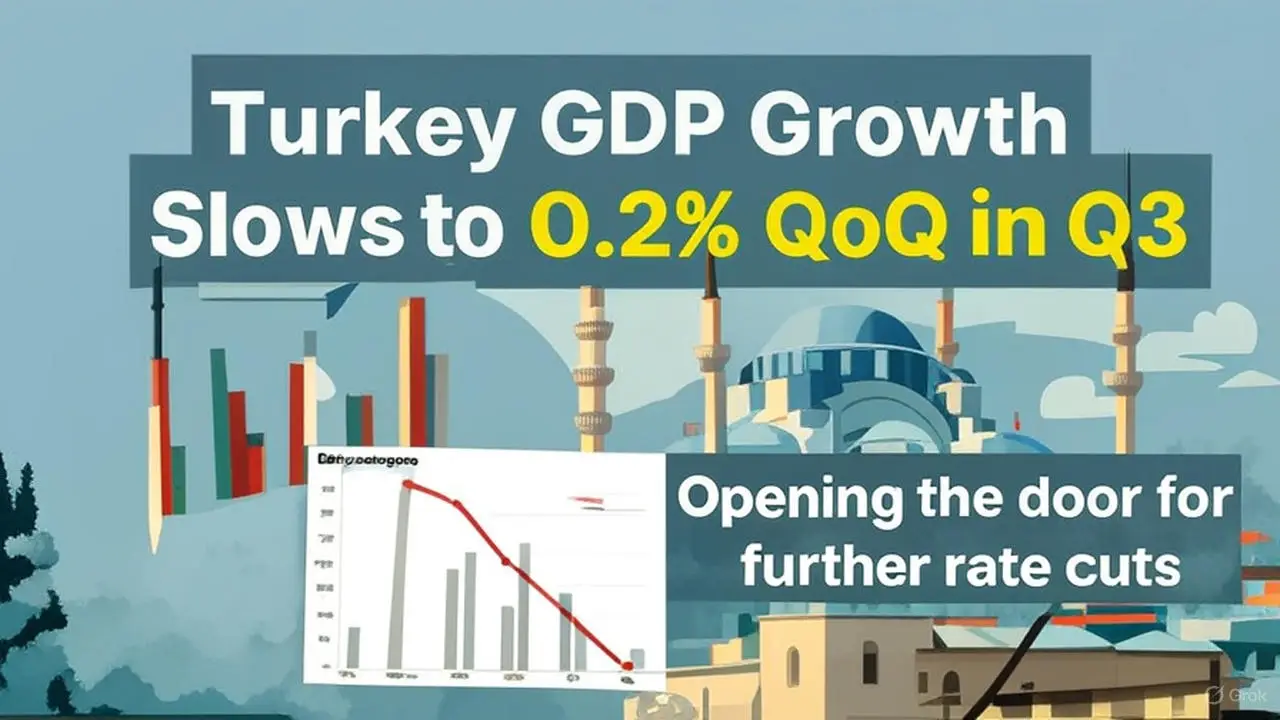
Turkey’s economy expanded at a much slower-than-expected pace in the third quarter of 2025, growing just 0.2% quarter-on-quarter in seasonally and calendar-adjusted terms, according to data released Monday by the Turkish Statistical Institute (TurkStat). Year-on-year growth came in at 2.4%, also below consensus forecasts of around 3–3.5%.
The sharp deceleration from 0.8% QoQ growth in Q2 reflects the cumulative impact of the central bank’s aggressive tightening cycle that began in mid-2023 and pushed the policy rate to 50% earlier this year. Private consumption contracted, investment remained subdued, and net exports provided only limited support despite a weaker lira.
Economists surveyed by Bloomberg had anticipated a more resilient performance, with median forecasts pointing to 0.7% QoQ expansion. The downside surprise reinforces expectations that the Central Bank of the Republic of Turkey (CBRT) now has additional room to ease monetary policy at its final meeting of the year on December 18 and into 2026.
“The weaker-than-expected growth print removes the last remaining hurdle for a December cut,” said Liam Peach, senior emerging markets economist at Capital Economics. “We now expect the CBRT to deliver a 250bp reduction this month, followed by another 500–750bp of easing in the first half of 2026.”
The central bank has already reduced its one-week repo rate by a cumulative 850 basis points since August, bringing it to 41.5% as of November. Governor Fatih Karahan has repeatedly stressed that the pace of future easing will remain data-dependent, with particular attention paid to underlying inflation trends and inflation expectations.
Headline inflation cooled to 47.1% in November from a peak above 75% in May 2024, and the CBRT’s latest forecasts see it ending 2025 around 21%. However, core inflation measures and services prices remain sticky, and the bank has cautioned that premature easing could jeopardize the disinflation process.
Market reaction was muted, with the BIST-100 little changed and the lira trading around 35.25 per dollar. Ten-year local-currency bond yields dipped roughly 20 basis points in early trading, signaling investor anticipation of further monetary accommodation.
Finance Minister Mehmet Şimşek welcomed the growth slowdown as evidence that the orthodox policy mix is working to rebalance the economy. “Temporary weakness in demand is the necessary cost of restoring price stability and sustainable growth,” he posted on X shortly after the data release.
Analysts caution that while the soft landing scenario remains intact, risks are tilted to the downside. Persistent geopolitical tensions, potential renewed lira volatility, and the lagged effects of prior tightening could push the economy toward stagnation or mild contraction in early 2026 if the central bank eases too aggressively.
For now, the Q3 GDP miss has solidified the view that Turkey’s monetary easing cycle still has significant room to run before policy reaches neutral territory—currently estimated by the CBRT around 20–25%.