
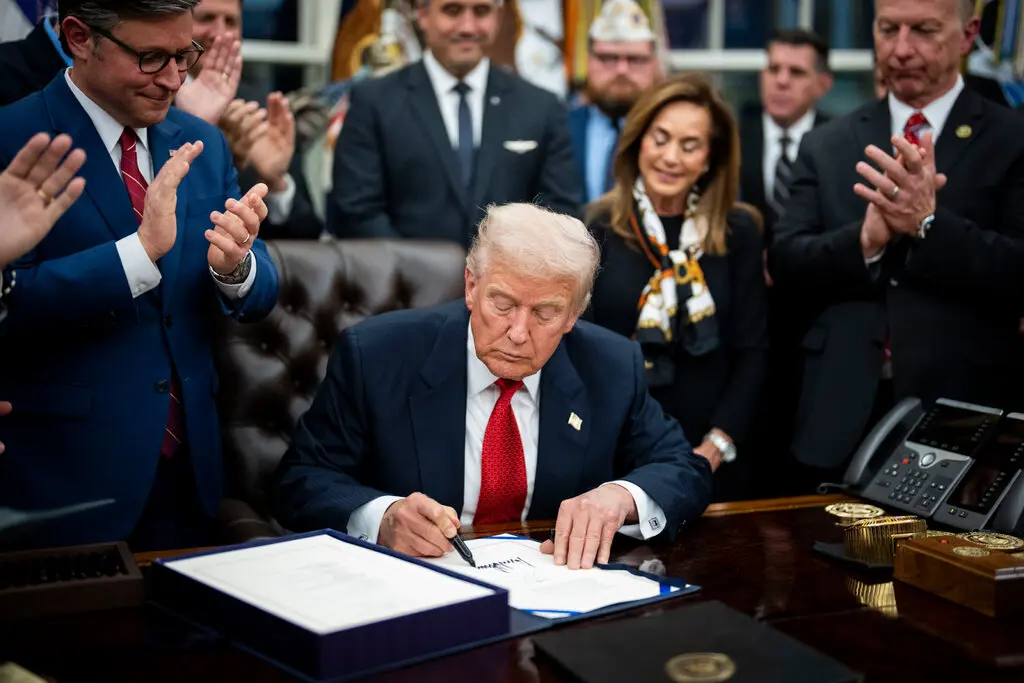
President Donald J. Trump announced Monday that he will sign an executive order this week establishing a single, nationwide regulatory framework for artificial intelligence—an action explicitly designed to strip states of their ability to impose their own AI laws.
In an all-caps post on Truth Social, the president declared:
“There must be only One Rulebook if we are going to continue to lead in AI… I will be doing a ONE RULE Executive Order this week. You can’t expect a company to get 50 Approvals every time they want to do something. We are beating ALL COUNTRIES at this point in the race, but that won’t last long if we are going to have 50 States, many of them bad actors, involved in RULES and the APPROVAL PROCESS…AI WILL BE DESTROYED IN ITS INFANCY!”
The announcement confirms and escalates a draft order that leaked in late November, which directed the Department of Justice and multiple federal agencies to aggressively preempt state-level AI regulation.
What the “ONE RULE” Order Is Expected to Do
Although the White House has not released the final text, administration officials and documents reviewed by multiple outlets indicate the order will contain at least five major components:
- Federal Preemption of State AI Laws
The order will assert that AI systems and models that operate across state lines fall exclusively under federal jurisdiction via the Commerce Clause, effectively nullifying conflicting state statutes. - Creation of an AI Litigation Task Force
Housed at the Department of Justice and led by the Attorney General or a designee, the task force will file lawsuits against states whose AI laws are deemed “onerous” or “anti-innovation.” California’s recently enacted safety-testing and transparency laws are widely expected to be among the first targets. - Agency-Level Enforcement Tools
- The Federal Trade Commission (FTC) will be instructed to treat certain state AI rules as “unfair methods of competition.”
- The Federal Communications Commission (FCC) may withhold billions in broadband-infrastructure grants from states that refuse to align with the federal framework.
- The Commerce Department will fast-track new “light-touch” national standards drafted in consultation with industry.
- Safe-Harbor Certification
Companies that comply with the forthcoming federal guidelines will receive a certification shielding them from most state-level enforcement actions and private lawsuits. - Repeal of Biden-Era Safeguards
The order will formally revoke the remaining portions of President Biden’s October 2023 AI executive order that imposed safety testing, watermarking, and red-teaming requirements on frontier models.
National Economic Council Director Kevin Hassett confirmed on CNBC Monday morning that President Trump personally reviewed a near-final draft over the weekend. “The president is adamant,” Hassett said. “One set of rules, one playbook, maximum speed. That’s how we beat China.”
A Long Lobbying Campaign Comes to Fruition
Silicon Valley’s largest players—OpenAI, Google, Meta, Anthropic, Andreessen Horowitz, and the Chamber of Commerce—have spent more than $120 million in 2025 alone lobbying for exactly this outcome.
In closed-door meetings and public letters, executives warned that a “patchwork” of state laws would add years and billions of dollars to development timelines, allowing Chinese competitors to leapfrog the United States. Sam Altman, CEO of OpenAI, testified before the Senate in September that “California’s new law alone would delay our next model by 18–24 months.”
The State-Level Backlash That Forced Trump’s Hand
Congress repeatedly refused to grant the preemption the industry wanted:
- July 2025: A Republican proposal for a 10-year moratorium on state AI regulation was stripped from the “One Big Beautiful Bill” in a stunning 99–1 Senate vote.
- December 2025: Language that would have slipped preemption into the National Defense Authorization Act was removed after fierce opposition from both parties.
With legislative routes closed, the White House turned to executive action—the same tool Trump used earlier in his second term to eliminate Biden-era export controls on advanced chips and to open federal datasets for commercial AI training.
Bipartisan Fury over Federal Overreach
The move has provoked an unusual alliance of critics.
Conservative champions of states’ rights were quick to condemn the plan. Rep. Marjorie Taylor Greene (R-GA) posted on X: “I love President Trump, but states MUST retain the right to regulate AI. This is federal overreach on steroids.”
Sen. Josh Hawley (R-MO), normally a Trump ally, called the order “a massive giveaway to West Coast billionaires at the expense of children and families who will suffer from unregulated deepfakes and algorithmic discrimination.”
On the left, Sen. Elizabeth Warren (D-MA) and Rep. Anna Eshoo (D-CA) issued a joint statement warning that the order “guts hard-fought consumer protections and hands the keys to our future to a handful of unaccountable tech CEOs.”
More than 400 civil-society organizations—including the ACLU, AFL-CIO, NAACP, and the Center for Democracy & Technology—signed an open letter last week declaring that “rushing to deregulate AI before we understand its harms is reckless and dangerous.”
Uncertain Legal Ground
Constitutional scholars are divided on whether the executive branch can unilaterally preempt state police powers in this area without explicit congressional authorization.
“The Commerce Clause is broad, but it’s not a blank check,” said Professor Laurence Tribe of Harvard Law School. “If the administration tries to withhold broadband funding as punishment, that will be challenged immediately—and the states will probably win.”
California Attorney General Rob Bonta has already signaled that the state will sue the moment the order is signed.
Timeline and Next Steps
White House Press Secretary Karoline Leavitt told reporters Monday that the signing ceremony is tentatively scheduled for Tuesday or Wednesday, December 9–10, 2025, and will feature CEOs from several leading AI companies.
Once signed, the AI Litigation Task Force is expected to file its first lawsuits before the end of January 2026, with California, Colorado, and New York atop the target list.
For now, the United States stands on the brink of the most sweeping federal deregulation of artificial intelligence in history—one that will either turbocharge American innovation or, as critics warn, unleash powerful systems with minimal public oversight.
As President Trump wrote in his closing line on Truth Social: “AMERICA WILL LEAD AI LIKE WE HAVE NEVER LED ANYTHING BEFORE—AND NOBODY WILL STOP US!”