
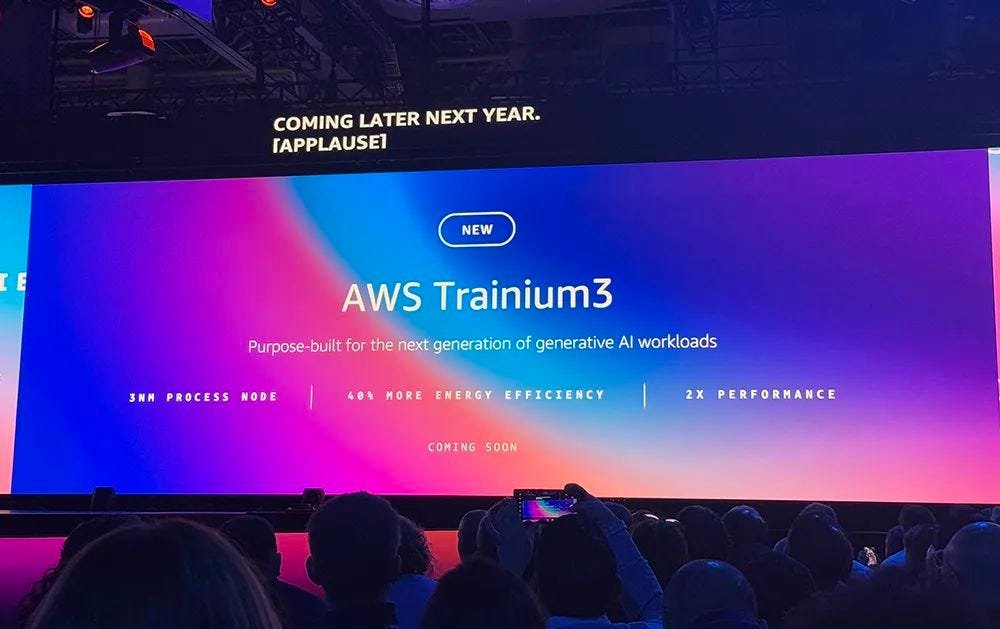
In a move that’s sending ripples through the tech world, Amazon (NASDAQ: AMZN) has unveiled its latest in-house AI chip, the Trainium3, positioning it as a game-changer in the hyper-competitive artificial intelligence hardware market. Announced late yesterday during a surprise AWS investor briefing, the new processor promises up to 50% better price-performance than Nvidia’s (NASDAQ: NVDA) flagship Blackwell GPUs, igniting a frenzy among investors and driving AMZN shares up over 4% in after-hours trading to an all-time high near $236. This surge caps a volatile year for the e-commerce giant, underscoring its aggressive pivot toward AI dominance amid soaring demand for cost-efficient computing power.
The announcement comes at a pivotal moment for Amazon, whose AWS cloud division has been pouring billions into AI infrastructure. With global AI spending projected to exceed $200 billion in 2026, Amazon’s push to wean itself off Nvidia’s “tax”—the premium prices for its GPUs—could not be timelier. “We’re not just building chips; we’re redefining what’s possible for AI at scale without breaking the bank,” said David Brown, AWS Vice President of Compute and Networking, during the reveal. The Trainium3, set for volume availability in early 2026, builds on the success of its predecessor, Trainium2, which already delivers 30-40% cost savings over comparable Nvidia hardware.
The Chip That Could Upend AI Economics
Amazon’s foray into custom silicon isn’t new—its Annapurna Labs, acquired in 2015, has churned out Graviton CPUs and earlier AI-focused Inferentia and Trainium chips. But Trainium3 represents a quantum leap. Engineered specifically for training massive language models, it boasts four times the performance and three times the memory of Trainium1, while slashing energy consumption by 40%. AWS claims real-world benchmarks show it handling workloads like Anthropic’s Claude models at half the cost of Nvidia’s H100 or Blackwell equivalents.
This isn’t mere hype. Early adopters, including startups like Databricks and enterprise heavyweights like Deutsche Telekom, have already tested Trainium2 clusters, reporting latency reductions and inference speeds that rival Nvidia without the supply chain headaches. Project Rainier, Amazon’s sprawling AI supercluster spanning U.S. data centers with over 500,000 Trainium2 chips (and expanding to 1 million by year-end), powers frontier AI research and has locked in multibillion-dollar commitments. The Trainium3’s preview teases even more: integrated networking at 600 gigabits per second, enabling seamless multicloud operations with partners like Google Cloud.
Critics, however, point to hurdles. Internal Amazon documents leaked earlier this year revealed startup gripes about Trainium’s performance lagging Nvidia in niche latency-sensitive tasks. Stability AI, for one, deemed Trainium2 “less competitive” for image generation due to speed trade-offs. Yet, AWS counters that for bulk training—the bread-and-butter of most AI firms—the cost edge is undeniable, potentially saving customers millions on hyperscale projects.
Stock Surge: A Vote of Confidence in Amazon’s AI Ambitions
The market’s reaction was swift and bullish. AMZN closed Monday at $233.16, up 1.8% on the day, before exploding 4.2% after hours to $236.42—its highest ever. This caps a remarkable rebound: After lagging the “Magnificent Seven” peers through much of 2025 (up just 2.27% year-to-date pre-announcement), the stock has now gained nearly 12% in the past month, fueled by Q3 earnings that smashed expectations with $180.17 billion in revenue and $1.95 EPS.
Analysts attribute the pop to Trainium3’s validation of Amazon’s $125 billion 2025 capex blitz—mostly AI data centers and chips. “This isn’t just hardware; it’s a moat,” said Oppenheimer’s Colin Sebastian, who hiked his price target to $305. The timing aligns with a landmark $38 billion OpenAI deal in November, where the AI pioneer committed to AWS for training future models—exclusively on Amazon silicon, skipping Nvidia entirely. That pact alone propelled AMZN to a $2 trillion market cap milestone, signaling hyperscalers’ shift toward diversified, cheaper alternatives.
| Key Metrics Post-Announcement | Value |
|---|---|
| Closing Price (Dec 1, 2025) | $233.16 |
| After-Hours High (Dec 1) | $236.42 |
| 1-Day Change | +4.2% |
| YTD Gain | +5.9% |
| Market Cap | ~$2.4T |
| P/E Ratio (TTM) | 42.5x |
Broader AI optimism played a role too. Nvidia’s dominance (78% market share) faces cracks as rivals like Amazon, Google (TPUs), and Microsoft (Maia) roll out ASICs—application-specific integrated circuits tailored for AI. Amazon’s edge? Vertical integration. Owning the full stack—from chips to Bedrock AI services—lets it undercut rivals on price while bundling with AWS’s 33% cloud market share.
Nvidia’s Shadow: Opportunity or Overhype?
Nvidia isn’t quaking—yet. CEO Jensen Huang touted Blackwell’s raw power at a recent keynote, dismissing custom chips as “niche.” But with Blackwell units fetching $30,000-$70,000 amid shortages, Amazon’s sub-$20,000 effective pricing (via cloud rentals) could erode Nvidia’s 95% training monopoly. AWS already deploys 250,000 Graviton chips for e-commerce peaks, proving in-house tech scales.
For investors, the surge raises bubble fears. Amazon’s free cash flow dipped to $14.8 billion TTM on capex overload, and regulatory scrutiny looms—EU probes into AWS dominance and U.S. antitrust suits could clip wings. Still, with AI workloads growing 150% QoQ on Trainium, bulls see $300/share by mid-2026.
Looking Ahead: AI’s Next Frontier
Amazon’s Trainium3 isn’t just a chip; it’s a manifesto against dependency. As CEO Andy Jassy ramps AI hiring (20,000 roles added in 2025), the company eyes government contracts—like a $50 billion U.S. supercomputing bid—and deeper ties with Anthropic ($8 billion invested). If Trainium3 delivers, it could fuel AWS’s return to 20%+ growth, turning today’s surge into tomorrow’s sustained rally.
In the AI arms race, Amazon isn’t playing catch-up—it’s rewriting the rules. For shareholders, it’s a reminder: Bet on the builder, not just the hype. AMZN may have surged on silicon specs, but its real power lies in execution. Watch this space.