
In February 2026, the web took a significant leap toward becoming truly “agentic.” Google and Microsoft jointly introduced WebMCP (Web Model Context Protocol) as an early preview in Chrome 146 Canary. This proposed browser standard allows websites to expose structured, callable tools directly to AI agents, transforming how artificial intelligence interacts with the internet.
No longer must AI agents rely on fragile screenshot analysis, DOM scraping, or simulated mouse clicks. Instead, they invoke precise JavaScript functions with typed parameters—making interactions faster, more reliable, and less resource-intensive.
WebMCP builds on the broader Model Context Protocol (MCP), extending its principles to the client-side browser. It promises collaborative human-AI workflows where users and agents share the same page context, with humans retaining oversight and control.
The Limitations of Today’s AI Web Agents
Current AI agents struggle with web interactions. Tools like browser automation libraries (e.g., Playwright or Puppeteer) or multimodal models that analyze screenshots force agents to “pretend” to be human users. They capture pixels, parse visual layouts, interpret HTML unpredictably, and simulate inputs.
This approach has severe drawbacks:
- Fragility: UI changes break agents instantly.
- Inefficiency: Processing screenshots consumes massive tokens and compute.
- Slow performance: Multi-step simulations take seconds or minutes.
- High costs: Vision models and repeated observations drain resources.
- Poor reliability: Misclicks, misreads, and hallucinations are common.
These issues limit agents to simple tasks and prevent scalable, real-world deployment. WebMCP addresses this by letting websites define exactly what actions agents can perform—and how.
The Foundation: Model Context Protocol (MCP)
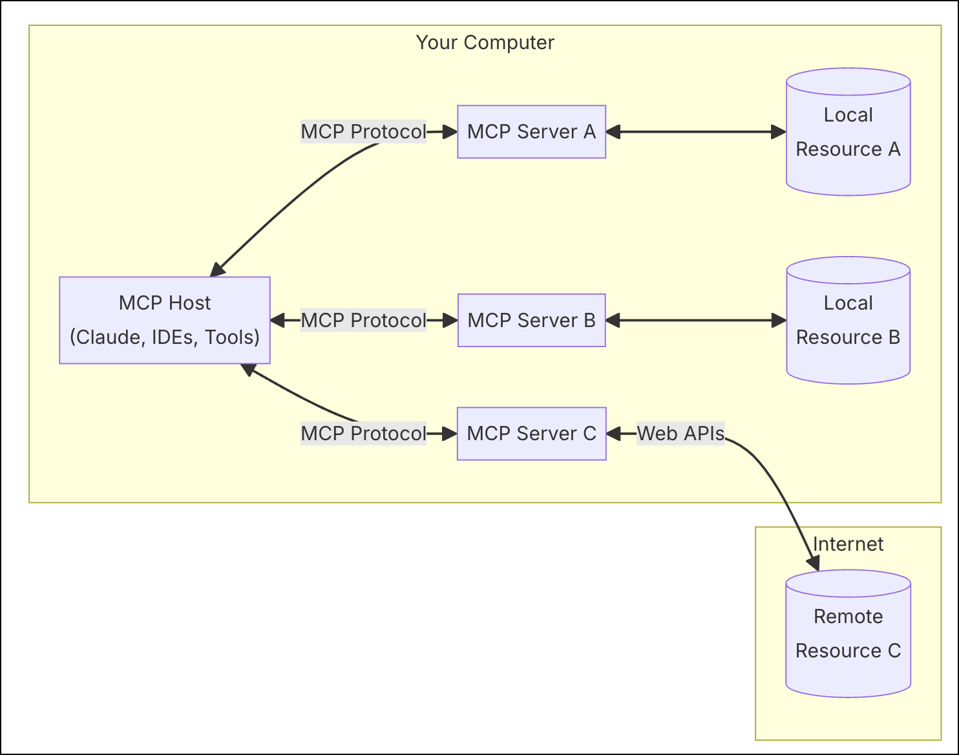
To understand WebMCP, start with MCP—the open protocol that standardizes how AI models access external tools and data.
Often called the “USB-C for AI,” MCP allows applications like Claude, ChatGPT, or IDEs to connect to backend services (calendars, databases, APIs) via structured tool calls. Instead of ad-hoc integrations, MCP defines a uniform way for models to discover tools, receive schemas, and invoke functions with JSON inputs/outputs.
MCP has gained traction in developer tools and enterprise workflows. WebMCP brings this paradigm to the browser, turning web pages into lightweight, client-side MCP servers.
What Exactly Is WebMCP?
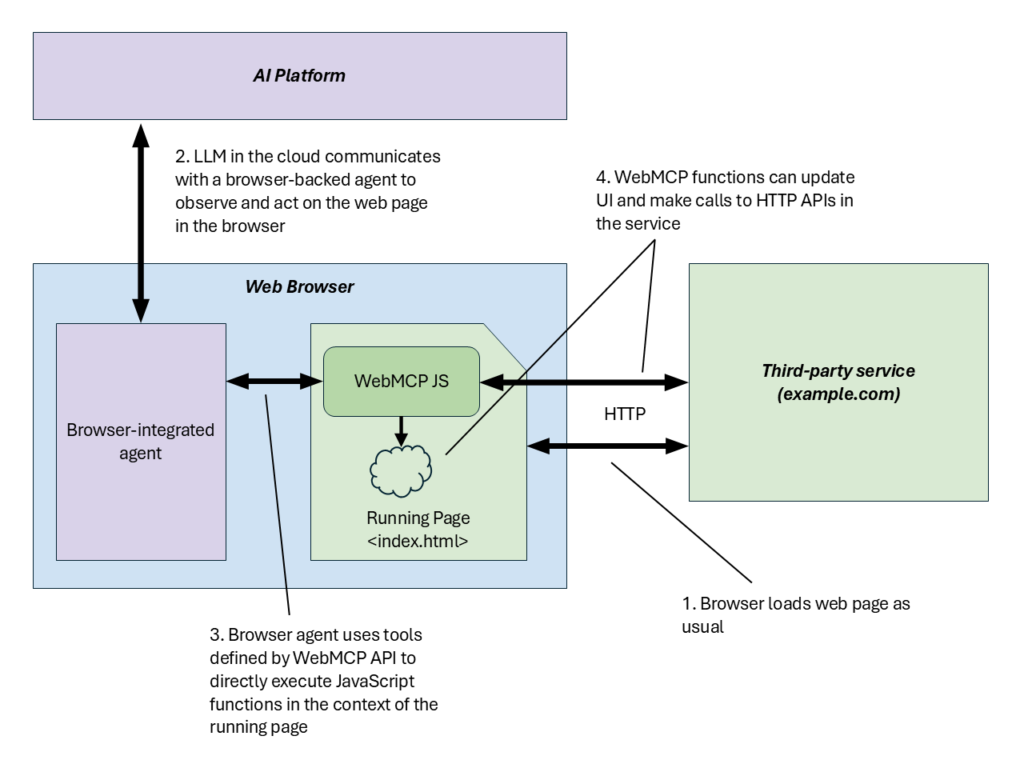
WebMCP is a proposed W3C standard incubated in the Web Machine Learning Community Group. It introduces a new browser API under navigator.modelContext, enabling websites to register “tools”—JavaScript functions with:
- Natural language descriptions
- Structured input schemas (JSON Schema)
- Execute callbacks
AI agents (browser extensions, assistants, or future built-in features) discover these tools, invoke them with validated parameters, and receive results. Execution occurs client-side, directly updating the page UI.
This keeps users and agents in sync: actions are visible, reversible, and collaborative.
WebMCP offers two complementary approaches:
- Declarative API: Minimal markup for standard form-based actions.
- Imperative API: Full JavaScript control for dynamic, complex tools.
How WebMCP Works: The Technical Details
The Imperative API
The core is the imperative API. Developers register tools via navigator.modelContext.
Key methods include:
provideContext(options): Registers a list of tools.registerTool(tool): Adds a single tool.unregisterTool(name): Removes a tool.clearContext(): Clears all.
A tool definition looks like this:
navigator.modelContext.registerTool({
  name: "searchFlights",
  description: "Search for available flights by origin, destination, and dates",
  inputSchema: {
    type: "object",
    properties: {
      origin: { type: "string" },
      destination: { type: "string" },
      departureDate: { type: "string", format: "date" },
      returnDate: { type: "string", format: "date", optional: true }
    },
    required: ["origin", "destination", "departureDate"]
  },
  execute: async (input, client) => {
    // Validate and perform search
    const results = await performFlightSearch(input);
    updateUI(results);
    return results;
  }
});
The execute callback receives input and a ModelContextClient object, which can request user interaction (e.g., for confirmation or CAPTCHA).
The Declarative API
For simpler cases, add attributes to HTML forms:
<form mcp-tool="searchProducts">
  <input name="query" type="text" required>
  <input name="category" type="string">
  <button type="submit">Search</button>
</form>
The browser infers the tool schema from form elements, enabling basic actions with almost no code.
Key Benefits of WebMCP
WebMCP offers transformative advantages:
- Reliability: Structured calls eliminate parsing errors.
- Speed: Single invocations replace dozens of steps.
- Efficiency: Reduces token usage and multimodal processing.
- Developer Control: Websites define supported actions, preventing unwanted scraping.
- Human-in-the-Loop: Users see and control agent actions.
- Accessibility: Assistive technologies reuse the same tools.
- Code Reuse: Leverages existing frontend logic without backend duplication.
Real-World Use Cases
Early demos highlight WebMCP’s potential:
- Travel Booking: An agent searches flights/hotels with precise filters and books directly.
- E-Commerce: Configure products, apply filters, and checkout seamlessly.
- Support Tickets: Auto-fill system details into forms.
- Data Dashboards: Navigate charts and export insights via natural language.
- Creative Tools: Apply edits like “make text bolder” in design apps.
In a travel site demo, agents use structured tools for flight searches instead of fragile vision-based clicking.
Current Status (February 2026)
As of February 16, 2026, WebMCP is in early preview:
- Available in Chrome 146 Canary (enable “WebMCP for testing” flag).
- Joint Google-Microsoft effort, with W3C incubation.
- Draft spec updated February 12, 2026.
- Early Preview Program offers docs, demos, and feedback channels.
Microsoft’s involvement suggests future Edge support. Polyfills exist for testing on other browsers. Stable rollout is expected later in 2026 or 2027.
Security and Privacy Considerations
WebMCP emphasizes security:
- Tools require explicit registration.
- Execution is same-origin by default.
- User permissions gate sensitive actions.
requestUserInteractionensures human oversight for critical steps.- Read-only hints prevent unintended mutations.
The draft includes a security section (still developing) to address cross-origin leaks and malicious tools.
The Future Impact of WebMCP
WebMCP could fundamentally change the web. By reducing scraping incentives, it may decrease bot traffic. It complements backend MCP for hybrid workflows. As browsers adopt it, expect richer AI assistants—perhaps built-in “Gemini in Chrome” or similar features.
For developers, it’s like schema.org for AI: a standardized way to make sites agent-ready. Early adopters gain visibility in emerging AI search and assistance ecosystems.
Conclusion
WebMCP marks a pivotal moment for the agentic web. By bridging websites and AI agents with structured, efficient tools, it enables collaborative, reliable interactions that were previously impossible.
As adoption grows through 2026, WebMCP will likely become as foundational as HTTPS or responsive design. Developers should experiment now—join the early preview and start making sites agent-ready.
The future of browsing isn’t just human—it’s human and AI, working side by side.